Official history of

Official history of
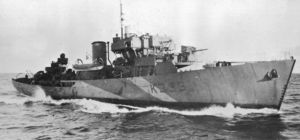
From the time the “Flower” class corvettes appeared on the convoy routes early in the Second World War, they earned a reputation for endurance and survival in foul weather. Their crews also found that they were lively and uncomfortable craft and their captains that their fuel tanks were not quite large enough to give them freedom of manoeuvre on a Western Ocean passage.
The corvettes of the revised “Flower” Class built under the 1940-41 programme had their forecastle decks extended aft as far as the funnel, increasing their seaworthiness and the comfort of their crews. The next two programmes provided for the revised “Flower” Class (increased Endurance) with a steaming range at 12 knots of about 5,100 instead of 3,450 miles.
HMCS NORTH BAY was one of the latter class of corvettes and was built by Collingwood Shipyards Ltd., Collingwood, Ontario. Her keel was laid on 24 September 1942, she was launched on 27 April and commissioned on 25 October 1943. She was 208’ 4” in length over all, 33’ 1” in breadth and drew 16’ 0” at full load, displacing 970 tons. She had a four-cylinder triple expansion engine of 2,750 horse-power which gave her a top speed of 16 knots. She was armed with a 4” gun and a “hedgehog” (an ahead-throwing anti-submarine spigot-mortar) forward and a 2-pounder pompom gun and depth charges aft.
NORTH BAY sailed from Collingwood on 29 October 1943. She picked up stores and ammunition at Toronto, Montreal and Quebec, besides having adjustments made to her equipment which always gives trouble in a new ship. Off Syndey, Cape Breton Island, she joined the escort of convoy SH-114 to Halifax where she arrived on 29 November.
At Halifax she was taken in hand by the dockyard to have her equipment completed and brought up to operational pitch so it was not until 28 January 1944 that NORTH BAY was ready to sail for St. John’s Newfoundland. She was allocated to Escort Group No. 9, and employed for a while on anti-submarine patrols before the group sailed for Britian. Soon after in Londonderry, on 8 April 1944, NORTH BAY was transferred to C-4 group and spent the rest of the year on the transatlantic convoy routes. The turning point in the Battle of the Atlantic had been passed a year before, but U-boats were present in the North Atlantic until May 1945 always threatening the convoys. NORTH BAY, as it happened, never encountered the enemy, but did expend depth charges on submarine targets – and not only in practice. Many objects in the sea can give echoes resembling a submarine at first. Such things have to be attacked lest they turn out to be U-boats. Eventually they vanish or are identified as wrecks or fish, but until that moment the battle is real to the submarine hunters.
With C-4 group, NORTH BAY made thirteen passages escorting convoys on the “Newfy-Derry” run until, on arrival off St. John’s in December, she was ordered to continue with the convoy to Halifax arriving on the seventh. There, and at Sydney she was refitted. She sailed to Bermuda on 27 February 1945 where she underwent “working-up” exercises to bring her again to a state of efficiency. On returning to St. John’s on 27 March, she was assigned to Escort Group C-2, but was detached to escort the SS Lord Kelvin, the British cable ship, to the Grand Banks to repair a cable. They spent thirteen days at sea, and, because of foul weather, could do no work on the cable beyond buoying the position of the break.
NORTH BAY was reallocated to C-3 group and between 30 April and 1 June escorted two convoys across the Atlantic. Her convoy duty has earned the battle honour “ATLANTIC 1944-45” for any future ship of the name.
On C-3’s arrival from its last convoy, it was dissolved. Corvettes were not being retained in the fleet for the final campaign in the Pacific, so NORTH BAY was paid off on 26 June and handed over to the War Assets Corporation for disposal on 1 July 1945. She was sold within a year and converted for service in the coasting trade. She was renamed successively Galloway Kent and Bedford II. She is still (1964) plying under the latter name, registered at Halifax and owned by Chebucto Steamships Ltd.
Naval Historical Section,
Naval Headquarters.
Ottawa, Ontario,
7 April, 1964.



 CFB Esquimalt Naval and Military Museum
 CFB Esquimalt Naval and Military Museum
 CFB Esquimalt Naval and Military Museum
 CFB Esquimalt Naval and Military Museum
 CFB Esquimalt Naval and Military Museum
 CFB Esquimalt Naval and Military Museum
 CFB Esquimalt Naval and Military Museum
 CFB Esquimalt Naval and Military Museum
 CFB Esquimalt Naval and Military Museum
 CFB Esquimalt Naval and Military Museum
 CFB Esquimalt Naval and Military Museum
 CFB Esquimalt Naval and Military Museum
 CFB Esquimalt Naval and Military Museum
 CFB Esquimalt Naval and Military Museum
 CFB Esquimalt Naval and Military Museum
 CFB Esquimalt Naval and Military Museum
 CFB Esquimalt Naval and Military Museum
 CFB Esquimalt Naval and Military Museum
 CFB Esquimalt Naval and Military Museum
 CFB Esquimalt Naval and Military Museum
 CFB Esquimalt Naval and Military Museum
 CFB Esquimalt Naval and Military Museum
 CFB Esquimalt Naval and Military Museum
 CFB Esquimalt Naval and Military Museum
 CFB Esquimalt Naval and Military Museum
 CFB Esquimalt Naval and Military Museum
 CFB Esquimalt Naval and Military Museum
 CFB Esquimalt Naval and Military Museum
 CFB Esquimalt Naval and Military Museum
 CFB Esquimalt Naval and Military Museum
 CFB Esquimalt Naval and Military Museum
 CFB Esquimalt Naval and Military Museum
 CFB Esquimalt Naval and Military Museum