Official History of

Official History of
Caution: This article contains dated, biased and/or racist language.
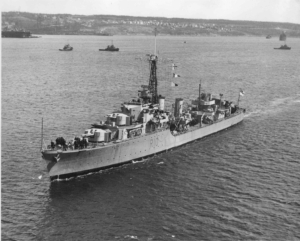
During her career, HMCS MICMAC, destroyer escort, was often fondly nicknamed “Old Dobbin” or described as the “work-horse of the East Coast”, for her’s was the patient, unspectacular, but always useful career of a training-ship and many, both officers and men, received their first taste of sea-life on her decks.
In the way of distinction she was the first destroyer and, up to that time, the largest warship, to be built in Canada. Three other “Tribals” followed her out of the shipyards at Halifax, namely NOOTKA, CAYUGA and ATHABASKAN, but she was the first of the four to hoist the White Ensign.
MICMAC’s keel was laid at the Halifax Shipyards on 20 May 1942, the first rivet being driven by the late Honourable Angus L. Macdonald, then Minister of National Defence for Naval Services. Her hull, numbered CN-278, was launched on 18 September 1943 in a ceremony which was broadcast by radio. Mrs. Angus Macdonald, wife of the Minister, christened the ship and many other notables were present, including the Minister himself, Vice-Admiral Percy W. Nelles, CB, RCN, Chief of the Naval Staff, and Rear-Admiral Leonard W. Murray, CBE, RCN, Commander-in-Chief Canadian North-west Atlantic. Among the invited guests were five Indian chiefs of the tribe whose name had been given to the destroyer.
On 8 May 1945, with the end of the war in the Atlantic, MICMAC was still not in commission. It was decided, however, that in the post-war fleet, she would be employed as a training-ship. From June on, she underwent trials. HMCS MICMAC was commissioned on 12 September 1945, being placed then under the administration of Captain (D), Halifax. Acting Lieutenant-Commander R. L. Hennessy, DSC, RCN, assumed command.
The Micmacs from whom the ship has derived her name, are an Algonquin tribe of Indians who at the time of the coming of the European were scattered about in small hunting groups in Nova Scotia, New Brunswick and Prince Edward Island. They were a notably warlike people. Although rather isolated they fought with the Algonquin tribes in the south, the Iroquoian tribes in the west, the Eskimo and Montagnais on the north shore of the Gulf of St. Lawrence and the Beothuk of Newfoundland. When the French arrived in the Maritimes, they became their staunch allies and fought with them for one hundred and fifty years against the British. They made peace with the latter in 1760 and, having made it, kept it faithfully.
As is often the case with warlike people, the Micmacs were cruel to prisoners. The males were frequently tortured to death. Women and children, however, were usually spared for absorption into the tribe. As hunters and fishermen they were skilful and courageous, going off to sea in their fragile bark canoes to harpoon seal and walrus.
The name of the tribe seems to have been derived from “Miscou”, the name of a Jesuit mission at the south end of the Bay of Chaleur, for it does not appear to have been used by the people to designate themselves (in the form of “Mik-mok”) until after their introduction to Christianity in this place. Their own name for themselves was “El’nu” meaning man as distinguished from the other animals, although the Rev. Silas Rand, well-known authority on the tribe, stated that they used a more particular name “Megumawaach” to differentiate themselves from other Indians. It is possible that the Micmacs, as is the case with many nomadic peoples, having only a weak tribal organization, used their individual clan names when talking of themselves and the general term “man” when referring to all others who were outside their particular clan.
One of the legends that is told of the Micmac culture hero Glooscap, states that his twin brother, who was as evil as Glooscap was good, tried persistently to kill him. One day, Glooscap, tiring of these attempts, seized a fern from the forest, pursued his evil twin and slew him with the plant.
The destroyer’s badge depicted a golden fern on an azure background. The purpose behind the choice of this plant was to remind one of Glooscap’s deed, the idea being that “it has a definite reference to a ship of war, as the suggestion is implied that even as fragile a weapon as a fern, when used in the cause of right, can become quite formidable. In other words, it is the spirit of those who use the weapons of war that makes for success in battle”.
The ship’s colours were blue and gold. The motto for the ship was, fittingly enough, a Micmac word, Melkedae, meaning “fearless”.
In October 1945, after escorting the transport Ile de France to Halifax, MICMAC ammunitioned ship in Shelburne, N.S., and made a second visit to the port when she conveyed the Commanding Officer Atlantic Coast there. Exercises were carried out in St. Margaret’s Bay near Halifax and the ship proceeded later to the naval training base, HMCS CORNWALLIS, near Digby, N.S., to embark trainees for gunnery and anti-submarine exercises.
In November 1945, at Halifax, MICMAC suffered some damage when the destroyer SIOUX, while coming alongside, struck her on the starboard side. In the same month the liner Queen Elizabeth then transporting troops, was escorted into Halifax. His Excellency the Governor-General of Canada, the Earl of Athlone, was aboard the liner. On the 23rd, MICMAC visited Charlottetown and was open to the public two days later, when more than two thousand persons came aboard. Flying conditions being uncertain at the time, the destroyer was asked to lend assistance in conveying General Crerar, formerly General Officer Commander-in-Chief of the First Canadian Army, and party, who were then visiting the Maritime Provinces. MICMAC embarked them and proceeded to Sydney. Later, she returned to Halifax with the District Officer Commanding Military District No. 6, Brigadier Stewart.
On 21 December 1945, while secured at Halifax, MICMAC was struck on the starboard quarter by the port bow of the tug Glenside. Damage was caused by the tug’s bow fender which was solidly frozen.
From 1 to 25 January 1946, MICMAC underwent repairs to her gunnery fire control system. The Commanding Officer Atlantic Coast proposed a programme for her including visits to ports on the Pacific, but Naval Headquarters pointed out that she was then the only destroyer in commission on the east coast and for this reason it was not desired that she should leave the Atlantic. On the 25th, she sailed for Bermuda to carry out eight weeks of intensive “new-entry” training, embarking twenty-five RN and RCN ratings, for passage. When she arrived in Bermuda, the ship came under the operational control of the Commander-in-Chief, America and West Indies Station.
The first week MICMAC remained in HM Dockyard exercising harbour drills and painting and cleaning ship. Thereafter she went out each Monday to Murray’s Anchorage and returned to the Dockyard on the following Saturday. Harbour exercises were carried out in Murray’s Anchorage and sea exercises in the practice area off Bermuda.
On 14 February, 1946, she met HM Corvette Caistor Castle with four Landing Craft Infantry. One of the latter, LCI 164, had broken down completely and MICMAC was obliged to stand by her during the night. At daylight she attempted to pass a Coston gun line to her. The attempt was made in a high wind and was unsuccessful. The destroyer then tried to come closer. Course was shaped up wind at 0715 and, when the landing craft was abeam, course was again altered, this time to port, to bring the wind and sea on the beam. Lines were successfully passed. Then it was seen that a collision was imminent. MICMAC’s starboard engine was put to half ahead but not in sufficient time to clear the landing craft’s stern which, lifted by a particularly heavy sea at 0745, collided with MICMAC’s port side. At 0806 the tow parted. MICMAC then took up a position ahead of the other and approached slowly astern. A ten-inch manilla hawser was passed. Close station was kept to avoid having too great a weight to tow in the water, the LCI’s forward winch being in poor condition. The fact that a second collision was imminent was not appreciated by those standing on MICMAC’s bridge as a clear view of the landing craft could not be obtained from there. When the quarter-deck gave warning of the danger the engines were put at “half ahead both”. The landing craft struck. Damage was done to the starboard quarter of the destroyer.
Maintaining the tow was difficult for it had been impossible to pass the landing craft any cable for her end of the tow-line. By the 18th, however, the weather had abated sufficiently to pass half a shackle of cable to her and from then on the tow continued without incident until the destroyer was relieved by HM Frigate Wear and returned to Bermuda. Until 5 March MICMAC remained in the dockyard undergoing repairs for the hull damage sustained in the collisions with the landing craft.
The destroyer returned to Halifax on 25 March 1946. On the 31st, in company with HMCS MIDDLESEX, Algerine escort vessel, she sailed to meet HMCS WARRIOR, aircraft carrier, off Sambro Light Vessel. While the carrier flew off her aircraft, MICMAC acted as attendant destroyer. Later, she took station ahead of WARRIOR and escorted her into harbour.
Operation “Torcom”, a torpedo-firing exercise which found MIDDLESEX performing as target ship, took MICMAC out to the Halifax Exercise Area in April 1946. On the 9th, HM Transport Aquitania was approaching Canadian shores with the Governor-General Designate of Canada embarked, Field Marshal Viscount Alexander of Tunis. MICMAC effected rendezvous with her on 10 April and accompanied her into Halifax. The destroyer at the time was under the temporary command of the Executive Officer, Lieutenant S. L. Slade, RCN.
MICMAC sailed again to Bermuda after ammunitioning at Shelburne on 23 April 1946. Intensive harbour and sea training for new-entry seamen went on until 21 May when, taking HMCS NEW LISKEARD, Algerine escort vessel, under her orders, she left for Halifax.
After a visit to Sydney on 3 June 1946, MICMAC proceeded in turn to Baddeck, N.S., Gaspe, P.Q., Dalhousie, N.B. on the Bay of Chaleur, Charlottetown, P.E.I., and Pictou, N.S.
In July 1946, MICMAC joined WARRIOR for flying exercises off Halifax. Because operations were hampered by fog, the two ships proceeded to the Gulf of St. Lawrence. Calling first at Miramichi Bay, they went on to Gaspe from which port they made several sallies to exercise.
Sailing from Halifax via St. Andrews, N.B., a visit was paid to Welshpool, Campobello Island, N.B., to attend the unveiling of the memorial for the late President Franklin D. Roosevelt.
In late August 1946, MICMAC went outside Halifax for anti-submarine exercises with HM Submarine Token. These exercises were interrupted when MICMAC joined NOOTKA to effect a rendezvous with SS Mauretania. Aboard the liner was the Chief of the Imperial General Staff, Field Marshal Viscount Montgomery of Alamein.
Looking for a more satisfactory area for their exercises, MICMAC and Token sailed for Pictou, N.S., on 2 September 1946. The weather was not cooperative and they were instructed to continue on to the waters north of Prince Edward Island. Conditions were no better there and the seas north of Cape Breton Island were about the same. They therefore altered round and returned to Halifax. After a torpedo-firing exercise with NOOTKA, MICMAC and Token in company shaped course for Saint John, N.B., and later, St. Andrews. Charlottetown and Quebec City were also visited.
On 21 January 1947, following a refit and trials, MICMAC slipped and proceeded to Bermuda with NOOTKA. On the way the two destroyers encountered strong winds accompanied by violent seas which forced them to heave to for several hours. Some slight damage was done to the superstructure of both ships and MICMAC had her motor boat stove in.
Off Bermuda the two ships engaged in gunnery and torpedo-firing exercises. On 13 February 1947 they were joined by HM Sloop Sparrow from whom they parted on the 15th, then sailed to Port of Spain, Trinidad. There were more exercises there, after which the ships shaped course for Bridgetown, Barbados, where they anchored in Carlisle Bay at 1002Q, the 26th.
In the Pacific at the same time the cruiser, HMCS UGANDA, and the destroyer, HMCS CRESCENT, were steaming toward the Canal Zone escorting HMCS WARRIOR. The carrier was left at the Canal and her escorts returned to Esquimalt.
MICMAC and NOOTKA left Barbados and proceeded to Colón to join WARRIOR. The three then headed eastward. Approaching Cuba they moved into the harbour at Havana on 15 March 1947 for a three-day visit. This was the first peacetime call made at this city since the year 1929 when the destroyer HMCS VANCOUVER stopped there. On Sunday the 16th, Commodore DeWolf of WARRIOR, accompanied by the Commanding Officers of NOOTKA and MICMAC, laid a wreath at the foot of the two plaques in Cathedral Square in honour of Pierre LeMoyne, Sieur d’Iberville, Montreal-born explorer who died of yellow fever in Havana in 1706 while aboard his ship Le Juste. In the Central Park in the city Commodore DeWolfe also placed a wreath at the foot of the monument to Cuba’s national hero, José Martí. The ships were then opened to visitors.
One of the highlights of this visit was the carnival procession which, it was noted, cast “its romantic spell over the entire city”.
Heavy weather set in upon the return to Bermuda preventing further training exercises even in the relatively sheltered anchorage in Grassy Bay. Nor had it improved by the 25th when the three ships sailed from the islands.
On arrival in Halifax on 27 March 1947, Lieutenant-Commander J. C. Littler, RCN, assumed command of MICMAC. At this time, also, the destroyer began a refit which lasted until 9 July 1947. On the 16th of that month, full-power trials were scheduled for her but, as it was foggy around Chebucto Head at the entrance of Halifax harbour, she delayed sailing while she awaited news of fog clearance. At 0855, information having been received which stated that visibility was increasing at Chebucto Head, the ship slipped and proceeded to sea. At 1230 visibility was estimated to be about six miles; a fishing vessel was in sight at four miles. At 1250, low-lying fog smoke was sighted ahead creeping to the north-east. Speed was reduced. Radar gave Sambro Light Vessel a bearing of 002 degrees at 6000 yards. The navigator was ordered to alter twenty degrees to starboard in order to make a clear run up towards the harbour entrance while keeping well clear of the light vessel. The destroyer then entered a dense and extensive fog patch. Up to this time radar had reported only the light vessel, the fishing vessel and the shore-line, but a minute later a new radar contact was sent up to the bridge. The order was given, “hard a-starboard” followed by “full astern both engines”, just as the 10,000 ton freighter SS Yarmouth County loomed up suddenly directly ahead. Collision was unavoidable; all that could be done was to try to lessen the blow by making it a glancing one. This was done, and Yarmouth County’s bow struck and glanced off the destroyer’s port side. MICMAC’s engines stopped and all aboard went to work at once to repair what damage they could and give aid to the injured. The Commanding Officer’s quarters aft were used as a first aid centre coupled with the existing sick-bay.
The main damage was confined to the port side above the water-line. Abaft No. 5 bulkhead the ship was reported to be dry and sound. At 1336, when MICMAC began to move slowly ahead, it was found that there was no strain on this bulkhead. Navigating by radar through the fog, the ship proceeded at a speed of four to six knots toward the harbour.
HAIDA came out with a medical officer embarked whom she transferred to MICMAC. The crippled destroyer continued to proceed at a slow speed with HAIDA and the tugs Riverton and Glendyne standing by until at 1915 she secured alongside the jetty in Halifax.
Casualties from this disaster were five killed, five missing (later discharged as dead) and fifteen injured. One of the missing was a dockyard worker.
The Board of Inquiry convened aboard the destroyer concluded that MICMAC’s failure to detect the presence of Yarmouth County until just before the collision was due to an obscured sector on the radar screen which extended from dead ahead to five degrees on the starboard bow. Yarmouth County was within this obscured sector until MICMAC altered course twenty degrees to starboard just before the collision.
On 28 July 1947 MICMAC entered the Dartmouth Slips for an assessment of damage. Afterward, it was decided to pay her off into the reserve fleet. Destoring commenced in the latter part of August and the paying off took place on 5 September 1947. In disposal of her ship’s company priority was given to the manning of the frigate ST. STEPHEN who was commissioned shortly afterward. To avoid undue deterioration and the expense of winterizing, it was proposed that the destroyer should be kept “hot” during the autumn and winter months.
With MICMAC paid off, NOOTKA was the only fully operational destroyer on the east coast, although HAIDA was acting as a training destroyer and bearing a training complement.
On 7 May 1948, MICMAC was placed in floating dry dock for her six-monthly docking. Her hull was painted on this occasion and some defective zinc plates were renewed.
On 25 July 1948, a decision was made to take MICMAC in hand for conversion to squid, the anti-submarine weapon which had practically replaced depth-charge and hedgehog armament. After conversion it was intended that she should commission with a ship’s company drawn from NOOTKA who, in her turn, would be paid off for conversion to squid.
It was at 1530, 16 November 1949, that MICMAC was commissioned for the second time, with Lieutenant-Commander F. C. Frewer, CD, RCN, as her Commanding Officer. After trials held in December and on 9 January 1950, she sailed for Bermuda for her working-up exercises.
On 18 January 1950, MICMAC sailed from Ireland Island, Bermuda, to meet the aircraft carrier, HMCS MAGNIFICENT. Joining her the next day, she came under the direct orders of Commander Task Group 215, Commodore K. F. Adams, RCN, flying his board pennant in MAGNIFICENT. Of special note among exercises undertaken with the carrier at this time were anti-submarine manoeuvres made in conjunction with US Submarine Argonaut. MICMAC and MAGNIFICENT finally sailed from these waters on 31 January and reached Halifax on 2 February 1950.
From 13 February to 14 April 1950, MICMAC and MAGNIFICENT participated with units of the Royal, US and Netherlands Navies in anti-submarine and air defence exercises in the Caribbean. The combined British, Canadian and US manoeuvres, designated CARIBEX, extended through the Antilles as far north as Charleston. The combined Netherlands-US exercises, which were not a part of CARIBEX, were held concurrently in the Guantanamo Bay operating area.
While the Canadian ships were en route to Charleston, South Carolina, one of MAGNIFICENT’s planes crashed on taking off; a flier was killed and another seriously injured. South of Charleston on the 25th, a Firefly aircraft crashed while trying to land and there was a flurry of excitement for MICMAC when she raced to the position to rescue the crew.
On 3 March 1950, the ships touched at Guantanamo Bay, Cuba, and went on to visit Havana on the 7th. Lavish hospitality and a continual round of entertainment was the lot of the ship’s company in the latter port.
On 15 March 1950, MICMAC and MAGNIFICENT sailed to begin manoeuvres in earnest. On the 20th, a rendezvous was effected with the Commander Task Force 22, Vice-Admiral R. V. Symonds-Taylor, C.B., DSC, flying his flag in HM Cruiser Glasgow. For the next three days this force comprising Glasgow, MICMAC, MAGNIFICENT, HM Frigate Snipe, and eight US destroyers, threaded its way north against an opposing force of eleven US submarines.
Following a four-day stay in Guantanamo, the task group augmented by the frigate and former sloop HMS Sparrow sailed for further exercises. On this occasion they were opposed not only by the eleven submarines but also by wave after wave of bombers flying off US carriers.
On 7 April 1950, MICMAC, MAGNIFICENT and HMC Frigate SWANSEA steamed into New York harbour. They went on from there to arrive back in Halifax on the 12th.
In May 1950, besides firing exercises, MICMAC engaged in anti-submarine exercises off Halifax with HM Submarine Astute. One evening, when the underwater craft came to the surface, it was promptly boarded and its grinning crew were taken “prisoners”. MICMAC and Astute formed Task Unit 213.1.1 and, toward the middle of the month, they made a visit to the Grand Manan area to try out water conditions there. A visit was also paid to Saint John, N.B. On the 27th MICMAC and Astute proceeded to sea with HMC Ships MAGNIFICENT, HURON, SWANSEA, NEW LISKEARD and PORTAGE, to take part in an operation known as “Neverfail” which was designed to display tactics and weapons of anti-submarine warfare for the benefit of members of the Permanent Joint Board on Defence who were then on an inspection tour. Although, despite its name, this operation had to be shortened due to heavy fog, it was pronounced “satisfactory” by the Board. MICMAC also had reason to approve of it since it was the first time since her re-commissioning that she had had the opportunity to work with any RCN units other than MAGNIFICENT with whom she had always been employed primarily as plane-guard.
While engaged in this very role with MAGNIFICENT on 7 June 1950, MICMAC had to go to the aid of a downed Firefly Aircraft. Astute and a fishing boat joined the rescue operations. The pilot was picked up but there was no trace of the seaman passenger who had accompanied him.
During July and until 11 August 1950, MICMAC was in the hands of HMC Dockyard for minor repairs and docking. Following the repairs there were trials and more plane-guarding with MAGNIFICENT.
On 23 August 1950, as members of Task Group 215.1, MAGNIFICENT, HURON and MICMAC left Halifax. Before them was a so-called “diplomatic cruise” during which they intended to visit some of the countries who were enrolled in the North Atlantic Treaty Organization (NATO) of which Canada herself was one of the original members, having joined in April 1949. The immediate destination of the squadron was Ireland but, as there was a great deal of exercising en route, the ships steamed 2776.8 miles before reaching Moville near Londonderry, Northern Ireland.
In Londonderry, personnel from the squadron attended anti-submarine courses held in the Joint Anti-Submarine School, HMS Sea Eagle. On 7 September 1950, MICMAC, HURON and HM Destroyer Crispin went out with HM Submarines Amphion and Alcide for anti-submarine exercises. On the 8th, classes of instruction in tactical warfare were attended in Sea Eagle and from the 11th to the 15th, MICMAC, MAGNIFICENT and HURON engaged in tactical exercises with units of the Royal Navy. On the 19th, the three Canadian ships sailed from Londonderry for Rosyth and on the 24th slipped from the latter port to shape course for Oslo, Norway. Leaving Norway on 2 October, Göteborg, Sweden, and Copenhagen, Denmark, were visited. In this last city great interest was shown in the ships. Over 5,000 visitors swarmed over the destroyers and many more over MAGNIFICENT.
On 9 October 1950, the squadron proceeded to Holland via the Skagerrak, experiencing comparatively rough weather and a heavy swell en route. Parting company with MAGNIFICENT off Ijmuiden, the destroyers embarked pilots and proceeded to Amsterdam through the North Sea Canal locks. The visit here was highlighted by an audience granted the Commanding Officers by Her Majesty the Queen of the Netherlands.
When the destroyers sailed for Antwerp on 16 October 1950, HURON was flying the flag of the Flag Officer Commanding Canadian Special Service Squadron. On arrival in the Belgian city a continuous round of official and unofficial functions began for the Canadians. The most important of these from the standpoint of the Commanding Officers was an audience with Prince Baudoin, at that time the heir to the Belgian throne. In the full five days MICMAC was at Antwerp, her Commanding Officer made seven official trips to Brussels by car, a distance of about forty-five miles.
Passing through the Straits of Dover at 2000A the 23rd, the ships secured alongside a jetty in the harbour of Cherbourg at 1600A the following day. On the 25th, the Commanding Officers accompanied the Flag Officer Commanding Canadian Special Service Squadron to Paris by air for a wreath-laying ceremony at the Arc de Triomphe and an official reception, returning to Cherbourg the 26th.
MICMAC carried out plane-guard duty with MAGNIFICENT on the 28th. On 1 November 1950, she and HURON secured alongside Alcantara Dock in Lisbon, Portugal. Lisbon was found to be an excellent liberty port. On the 4th, the squadron slipped shaping course for the southward, steaming at slow speed. Cruising off the coast of Morocco in the afternoon of the 5th, MICMAC performed plane-guard duty while aircraft were flown off MAGNIFICENT.
The squadron arrived in Gibraltar the next day. For the next three days there were exercises with units of the Home Fleet. The light fleet aircraft carrier HMS Vengeance, HM Cruiser Cleopatra and the 4th Destroyer Flotilla – Agincourt, Gabbard, Corunna – participated with the Canadian Special Service Squadron in anti-submarine, air defence and other exercises.
The Canadian squadron sailed for Bermuda on 11 November 1950, arriving in the islands on the 20th. Here they were joined by the frigates LA HULLOISE and SWANSEA. Exercises were engaged in but were somewhat hampered by the weather. When they returned to Halifax at 0900, 27 November 1950, they secured at the jetty in a brisk wind.
During most of December 1950, the ship lay alongside in Dartmouth while repairs were made to her hull.
On 22 January 1951, MICMAC and HURON sailed for Bermuda. After refuelling in the South Basin, Ireland Island, they slipped to shape course for Panama via the Windward Passage between Haiti and Cuba. At Colón the ships parted company, HURON passing through the Canal to enter the Pacific. MICMAC, left behind in Colón, found the city a poor liberty port. Nearing Jamaica on 1 February 1951, a pilot was embarked off Port Royal. In Kingston private hospitality and entertainment were lavish. These included baseball and water polo games, an alligator shoot and shark fishing expedition. MICMAC held a reception on board to repay her hospitable hosts.
Leaving Jamaica the destroyer was back in HM Dockyard, Ireland Island, Bermuda, on 8 February. A quiet weekend was passed there, highlighted by a ship’s company picnic at the recreational field. Beginning on the 14th, exercises were held with CRESCENT. Two members of the National Research Council who were making a study of sea-sickness were transferred from MAGNIFICENT to MICMAC, but they were not seen above-decks for they immediately fell prey to the very malady they had come to study.
On 19 March 1951, course was shaped for Bermuda in company with MAGNIFICENT for whom MICMAC performed the duties of plane-guard. On 3 April, while en route to Trinidad, MICMAC was despatched by MAGNIFICENT to investigate a merchant ship who had broken down and had been drifting for two days. This turned out to be a small passenger vessel Gilbert Jr. of Dominican registry, out of Ciudad Trujillo and bound for Curaçao with a crew of sixteen and twelve passengers, eight of whom were women. In addition, two horses and a flock of chickens were penned on the after-deck. When MICMAC asked about the cause of the vessel’s breakdown which occurred 190 miles from her destination, the destroyer was informed that the Chief Engineer had neglected, because of a going-away party, to fill his fuel tanks.
It was necessary to take Gilbert Jr. in tow. The stopped ship, however, carried no spare gear whatsoever, all her hawsers were rotten, and her deck fittings, including the anchor cable, so corroded that it was immediately apparent that all the gear would have to be provided by MICMAC. A berthing wire was sent over by boat. It was wrapped around the foc’s’le hatch and the ends were fed out the port and starboard fairleads. The tow then got under way but parted at 1630 after seven and a half hours of towing, due to the chafing at the fairleads caused by Gilbert Jr.’s violent pitching. This break was repaired and course was shaped for Willemstad, Curaçao, which was reached the following afternoon at an average speed of just under nine knots.
MICMAC and MAGNIFICENT carried out more exercises off Port of Spain, Trinidad, and then moved on to Bridgetown, Barbados, anchoring in Carlisle Bay. There were no berths alongside and, to reach shore, a boat had to be regularly run through a heavy ground swell but, despite this inconvenience, Barbados was in the estimation of the Commanding Officer and his men, the finest liberty port the destroyer had visited “during the present commission”. Profuse hospitality, well-organized entertainment and an abundance of inexpensive shops and beautiful sand beaches – all were to be had.
Boston was next visited. Starting 23 April 1951 a strenuous round of official and unofficial functions went on during the four days of the visit. The rest of the spring and early summer was spent at Halifax, partly in Naval Air exercises and partly in refit.
On 7 August 1951, MICMAC left Halifax to join MAGNIFICENT off Chebucto Head and both ships shaped course to the eastward and Gibraltar.
The weather was almost “fantastically fine” on this voyage. On 10 August 1951, an engine failure caused a Sea Fury from MAGNIFICENT to fall into the sea twenty-five miles distant from MICMAC. The destroyer moved at full speed to the rescue, preparing blankets and first-aid the while, but, when she arrived on the scene she found “a perfectly healthy and dry Sub-Lieutenant pilot paddling happily around in his rubber dinghy basking in the sun”.
When the ships arrived in Gibraltar on 16 August 1951, the harbour was “very empty indeed, with the Fleet away on exercises and HMS Childers, the reserve destroyer, lying in a semi-commissioned solitary state at a buoy in the stream”.
On the 21st, MICMAC detached to berth in Valetta, Malta, securing bow-and-stern ahead of the Depot and Repair ship, HMS Tyne. A visit to Cyprus had also been placed on the schedule but it had to be cancelled owing to an outbreak of “polio” in MAGNIFICENT.
Off Malta there were daily exercises during weekdays. On one occasion, after depth-charges had been dropped, a turtle, two feet in diameter, was picked up and transferred to MAGNIFICENT as a birthday present to the Commodore.
On leaving Malta for Italy on 24 September 1951, MICMAC and MAGNIFICENT steamed in company with the light fleet aircraft carrier HMS Ocean and HM Destroyer Cheviot. Operation “Moosehunt” was carried out en route but, as this was chiefly an anti-submarine hunt by aircraft and MICMAC’s main role was that of plane-guard, the Canadian destroyer took little active part.
After giving a National Salute and a salute to the local Flag Officer in Command, both of which were returned by a shore battery, MAGNIFICENT and MICMAC berthed in Naples on 25 September 1951. There was a great deal of entertainment here and it did not let up during the five days the ships were in port.
“Symphonie Deux”, a tactical operation with French and British units in the Mediterranean, dominated the month of October 1951. On the 3rd, a conference was held in the French cruiser Georges Leygues to discuss the exercises. The Commanding Officer of MICMAC attended.
A wide variety of tactical exercises took place during the next ten days, both at sea and in harbour. What particularly impressed the Commanding Officer of MICMAC was the efficient manner in which the French units coped with British communications. During what at times developed into quite complicated manoeuvres, there was no show of any serious confusion, all of which “testified to the intensive inter-ally training which has been continuously progressed in the Mediterranean theatre”.
On 12 October 1951, a post-exercise conference was held in the Repair and Depot ship, HMS Forth. On the 16th, MAGNIFICENT and MICMAC called at Gibraltar for fuel. They then shaped course for the westward. On the 21st, MICMAC went alongside the carrier to fuel but a defective oil hose brought an abrupt end to the operation. This necessitated an anxious husbanding of fuel for the remainder of the passage and resulted in the destroyer arriving in Halifax on the 24th with less than forty tons of oil and two fuel tanks flooded for stability.
On 7-8 November 1951, Their Royal Highnesses Princess Elizabeth and the Duke of Edinburgh visited Halifax on the last stage of their Canadian tour. On the 8th, MICMAC sailed for Charlottetown to join the cruiser ONTARIO and escort her during the period the royal party was embarked on the passage to Sydney and St. John’s.
This was MICMAC’s last duty during her second commission. On 30 November 1951, she was paid off into the Reserve Fleet. However, in the following year – 1952 – it was decided to bring her forward again and convert her to the status of a “destroyer escort”.
At 1600 on 14 August 1953, HMCS MICMAC was commissioned for the third time in Her Majesty’s Canadian Dockyard at Halifax, N.S.
For the commissioning ceremony a guard of twenty-four men was drawn up on the jetty and they were joined by the Royal Marine Band of HM Cruiser Superb. A large number of naval officials and local civic dignitaries attended both the ceremony and the reception later held in the ship. The ship’s company was addressed by the new Commanding Officer, Commander George M. Wadds, CD, RCN, and Captain J. C. Littler, CD, RCN, representing the Flag Officer Atlantic Coast who was then absent from the port.
The remainder of the month and September were devoted to trials. In September also, a four-day visit was paid to Lunenburg, N.S., on the occasion of that town’s Centennial Celebration and Annual Fisheries Exhibition.
On 23 October 1953, the ship slipped with the intent of sailing to Bermuda, but a leak which developed at the junction of numbers 5 and 6 fuel tanks obliged the ship, because of the fire hazard, to return to Halifax. The interrupted sailing was resumed on the 27th.
In the waters off Bermuda working-up exercises were carried out in company with the frigate PRESTONIAN and escort vessels PORTAGE and WALLACEBURG. Before she returned to Halifax, the destroyer escort visited Brooklyn, New York, arriving there 10 November 1953.
On the 20th, MICMAC slipped to take up station in the seas north-east of Newfoundland to be available for search and rescue duties for the royal aircraft which was scheduled to arrive bearing Her Majesty the Queen on the first leg of her round-the-world tour. Because of the weather, speculation arose as to the possibility of the flight being postponed. However, about midnight on the 23rd, radar contacts were obtained and from 0130 on the 24th, the royal aircraft was reported Gander-bound.
Another voyage to Bermuda, this time with Sea Cadets aboard, was made on 5 February 1954, in the company of HM Submarine Tally-Ho. In St. George, Bermuda, the ships encountered the Danish training-ship Danmark, a square-rigged sailing ship who was preparing to make her return passage to Copenhagen after six months training in the West Indies.
Still another voyage to Bermuda was made on 5 March 1954, again in company with Tally-Ho. On the 18th, the mayor of St. George was embarked and the destroyer escort sailed for New York, arriving the 20th. MICMAC was back in Halifax on the 24th.
On 5 April 1954, nine officers from the Junior Officers Technical and Leadership Course (K) were embarked and a two-week training cruise was made to Providence, Rhode Island. Before this, on the third, in Halifax, a small fire had broken out in the Chief and Petty Officers’ pantry and on the ship’s return she remained alongside from 17 to 25 April to make good electrical defects caused by the fire.
A three-week cruise began on 26 April 1954, when the ship left for Norfolk, Virginia. This was the first the ship had made since beginning her third commission without training classes aboard. Nassau and San Juan, Puerto Rico, were also visited. In the latter port tours were taken through the historical points of interest in the island, many of which date back to 1493 when Columbus visited there. At the entrance to the harbour of San Juan, Morro Castle, once a formidable adversary to foreign ships, received the Canadians peacefully as tourists. After leaving this port the ship called at Bermuda where she found an opportunity to paint ship and work up the ship’s company in preparation for a scheduled visit to England to take part in the Royal Naval Volunteer Reserve Jubilee.
MICMAC left for Portsmouth, England, on 30 May 1954. Before sailing from Halifax she embarked two officers and twenty-two men of the Royal Canadian Navy (Reserve) who were to form Canada’s contingent to the Jubilee. Eight additional officers were embarked, including a Lieutenant Ernest S. Conolly, RNVR (Retired), aged seventy-seven years, of Bowen Island, B.C.
On the third day out from Halifax a vast iceberg was encountered. The destroyer escort passed within two miles of this great block of ice; its position was reported to the International Ice Patrol.
In Ponta Delgada in the Azores all officers and men “turned to” and painted ship, the task being completed in four hours and four minutes. The British Consul resident in the islands helped to make the visit a pleasant one. A bus tour was arranged for fifty men and this proved interesting. Horta was also visited and it was found to have a large British, American and Canadian colony, some forty to fifty families in all. Because of the hospitality of these people, Horta received a particular recommendation as a desirable port-of-call.
On 8 June 1954, in Portsmouth, reservists were transferred to RN barracks where they trained for the Jubilee parade under the guidance of Captain Robert I. Hendy, VRD, RCN(R), Commanding Officer of HMCS YORK, who was in charge of the entire Commonwealth contingent.
Joining the representatives of other Commonwealth navies the Canadian contingent marched in review before Her Majesty the Queen on 12 June 1954. The marchers were past and present members of the Reserve and numbered some 2,000 in all.
While in Portsmouth, the Officers in MICMAC were guests of the wardroom in the Royal Yacht Britannia.
On 14 June 1954 course was again shaped for the Azores. About one hundred and forty miles out of Portsmouth a homing pigeon sought refuge in the ship. The bird was apparently off course and was tired. Given food and warmth it soon recovered its strength and took off again to resume its way to its unknown destination.
On the 17th, MICMAC berthed once more at Ponta Delgada. On this occasion the harbour was found to be filled with the naval ships of six NATO countries: Netherlands, Denmark, Norway, France, Portugal and Canada. There was also one from Spain. Calls were exchanged by all. MICMAC held a reception for government, naval and military officials of the Azores, while a bus tour of the highly-cultivated and beautiful island of St. Michael’s was taken by some eighty of her officers and men.
MICMAC was back in Halifax on 23 June 1954.
A trip was made to Ireland Island, Bermuda, in July 1954 with seventy-five men from the gunnery school aboard. At the end of the month, in Bedford Basin, Halifax, MICMAC provided the background for the shooting of an instructional film “Anchors and Cables”.
On 2 August 1954, MICMAC left Halifax, her normal complement swelled by thirty-six cadets from various parts of Canada. On the 5th, off the Straits of Belle Isle, she met HM Yacht Britannia who was en route to the St. Lawrence River to meet HRH the Duke of Edinburgh then on the last leg of his Canadian tour. Coming under the orders of the Flag Officer Royal Yachts, MICMAC escorted Britannia up to Montreal. Here the destroyer escort opened her decks to visitors and several thousands availed themselves of the opportunity to inspect her. During the stay in the port, the chief and petty officers of Britannia entertained those of their corresponding rates in MICMAC at a reception held on board the royal vessel. When the two ships sailed down to Quebec City the chief and petty officers of MICMAC had the opportunity to return the courtesy. In Quebec, the Duke visited the royal yacht and MICMAC supplied guard boats and sentries for the occasion. His Royal Highness, however, did not board the yacht for passage immediately but went on by plane to Goose Bay, Labrador. The two ships followed, setting out at high speed. This pace was relaxed only when a dense fog settled down while they were passing through waters scattered with icebergs. The Duke of Edinburgh was finally embarked in Goose Bay and, when the royal yacht sailed out to sea, MICMAC preceded her. Shortly afterwards, they were joined by HMC Cruiser QUEBEC.
At 1230, 18 August 1954, a chief petty officer serving in QUEBEC came down with an acute case of appendicitis. As the cruiser had to remain with the royal yacht, the ailing man was transferred by jackstay to MICMAC and the destroyer escort was ordered to detach and proceed at once to Halifax. Before she left, MICMAC’s ship’s company gave His Royal Highness three parting cheers.
It had been hoped that MICMAC could reach Halifax and turn the patient over to the Royal Canadian Naval Hospital in HMCS STADACONA, but, as he became steadily worse, it became imperative to find medical attention closer at hand. The destroyer escort accordingly set out at full speed for St. Anthony which is the site of a Grenfell Mission hospital on the east coast of the northern tip of Newfoundland. On arrival, the chief petty officer was lowered into the ship’s motor boat and taken ashore. Rear-Admiral Frank Houghton who had had a long and distinguished career in the Royal Canadian Navy was executive manager of the international Grenfell Missions and, by coincidence, was discovered to be present at the time in St. Anthony. He was invited to make a midnight visit to the ship.
On 27 August 1954, in Halifax, Commander J. C. Smyth, CD, RCN, assumed command of the ship, taking over from Commander Wadds.
On 14 September His Excellency the Governor-General of Canada, the Rt. Hon. Vincent Massey, with party, Rear-Admiral R. E. S. Bidwell, Flag Officer Atlantic Coast, and Commodore E. P. Tisdall, Honorary Naval Aide-de-Camp to the Governor-General, were embarked for passage to Lunenburg. In the town hall of this fishing port an official welcome was given to the party and a tour made of the Fisheries Exhibition. A buffet supper followed at the home of His Worship the Mayor.
After the viceregal party was conveyed back to Halifax, MICMAC returned to Lunenburg for five days to take part in the festival. The escort vessels USS Johnnie Hutchins and Cross and the Algerine escort vessel HMCS PORTAGE were also present. These ships were dressed overall and were open to visitors daily.
With twenty men embarked for training, MICMAC slipped at Halifax on 7 October 1954. Proceeding southward she arrived on the 10th at the mouth of the St. John’s River below Jacksonville, Florida. A pilot was embarked and passage was made up the river, a distance of about twenty miles, to the city. This was believed to be the first time the port had been visited by a Canadian warship. A reader, however, of Crowsnest, the Navy magazine, later pointed out that it had been visited by six Fairmiles of the 72nd ML Flotilla in March 1943.
MICMAC found the city beautiful and the entertainment overwhelming. The regional Golden Gloves elimination was being held at the time and, an invitation being extended to participate, the ship entered five boxers two of whom were successful in winning their bouts. On the fourth day of the visit, a tour was arranged for one hundred officers and men to Florida’s oldest city, St. Augustine. On arrival, the so-called “Micmacs” were welcomed by the mayor and other prominent citizens. The Fountain of Youth, an alligator farm and other interesting spots were visited.
A call at Havana had been scheduled. “Hurricane Hazel”, however, was then rampant in the Atlantic. Close liaison was maintained with the meteorologist at the Naval Air Station in Jacksonville and, after information had been received from there that the hurricane was expected to hit the Florida coast and consultation had been made with U.S. Naval authorities, it was decided to remain in Jacksonville as going on to Havana would take the ship directly through the path of the hurricane. For protection the ship moved further up-river and she was firmly secured with hurricane hawsers. Fortunately, “Hazel” passed by some one hundred and fifty miles off the coast and the city felt relatively little effect from her passing. To make up for the disappointment caused by the cancelled visit to Havana, more entertainment was offered by the good citizens of Jacksonville.
MICMAC arrived back in Halifax on 18 October 1954. Getting up steam again, she slipped on the 25th and paid visits to Shelburne, where she was joined by the frigate BUCKINGHAM, and Yarmouth, N.S. At the latter town, both ships were open to visitors and the citizens responded to the courtesy by providing entertainment for all members of the ships’ companies.
MICMAC began a refit in December 1954. This and the trials which succeeded it were completed in April 1955. She then, on the 18th, proceeded to effect a rendezvous with MAGNIFICENT and HAIDA. The three ships making up Task Group 301.1 steamed southward to Puerto Rico, rounding Ponta Morro and proceeding up the harbour of San Juan on the 23rd. For several days they used this city as a base for sailing out to exercise. On the 28th they sailed for Bermuda.
While exercising in the waters south of Bermuda with US Submarine Argonaut, MICMAC received a request from the underwater craft to fire a full pattern of live squid so that the crew of Argonaut might be given “some experience as to what they might come up against in time of war”. Accordingly, after the submarine dived to periscope depth, MICMAC shot off a pattern of squid ahead set to a depth of one hundred feet. These were fired when the periscope was fifteen degrees forward of MICMAC’s beam. When the submarine surfaced its Commanding Officer assured MICMAC that the effect of the pattern had been just what he had wanted and that his crew would hereafter have a healthy respect for the effectiveness of the bombs.
When, at the beginning of June, the Task Group departed from Bermuda, they were obliged to run through very rough seas and passing rain squalls. Owing to the angry weather, the destroyers were unable to fuel alongside MAGNIFICENT and, when it began to moderate on the 3rd, MICMAC was down to 37% of her fuel. After the quietening waters permitted the operation, the carrier despatched one of her boats and transferred the Commanding Officers of the destroyers to her decks. The object of the conference which followed was to discuss the details of Exercise “Fogbank” which was due to start 5 June. On the return to the destroyers the boat conveying the Commanding Officers broke down and the Task Group was “treated to the rather unsalutary situation of two commanding officers adrift in a boat in mid-Atlantic”. However, the embarrassing situation was soon corrected when boats from MICMAC and HAIDA came to the rescue.
In one phase of Exercise “Fogbank” MICMAC was detached to form part of a convoy escort with the frigate PENETANG acting as commodore of the convoy. True to its name the successful carrying-out of the exercise was hampered by poor visibility.
On 7 June 1955, near the approaches to Halifax, MAGNIFICENT flew off her aircraft to the base at HMCS SHEARWATER. Following this, the Task Group steamed to a rendezvous with Task Unit 301.1.2 comprising HMC Frigates TORONTO, LAUZON, PRESTONIAN and PENETANG. The entire fleet of seven ships then proceeded into Halifax harbour in line ahead, a sight, MICMAC’s Commanding Officer observed, “not often given to the citizens of Halifax”. On passing Ives Point, MAGNIFICENT saluted the flag of the Flag Officer Atlantic Coast. The salute was returned from a naval battery located at the Seaward Defence Base.
On 7 July 1955, MICMAC and HAIDA paid a visit to Bar Harbour, Maine. They found here little in the way of distraction for the ship’s company.
On 17 August 1955 off Halifax, MAGNIFICENT and MICMAC joined the destroyers HURON, HAIDA and CRUSADER and all ships sailed in company. MICMAC had started out as plane-guard to the carrier but she relinquished these duties to HAIDA and, together with HURON and CRUSADER, formed a concentric screen around the carrier. In the evening the group steamed in line ahead toward New York.
Off the approaches to New York harbour on the 18th, the ships were instructed to proceed past the Ambrose Light Vessel at ten minute intervals. The cruiser QUEBEC had now joined and she and MAGNIFICENT took van positions. No pilots were embarked and the passage to the pier on the Hudson River was accomplished without incident. As soon as they could leave their ships, the Commanding Officers attended a luncheon given by the Canadian representative to the United Nations Organization. Members of the Commonwealth diplomatic corps and United Nations representatives were among those present.
In New York there was entertainment for all members of the ship’s company. The ship was opened to visitors and, despite the exceptionally humid weather, a total of 1,125 people came aboard.
On 22 August 1955, the US Submarine Halfbeak which had been secured astern of MICMAC, struck, while slipping, the starboard propeller guard of the destroyer escort. US Navy divers were sent down and they found a very slight tip damage on the propeller. However, it was not sufficiently great to make the ship unfit for sea.
Toward the end of the month exercises were carried out in the area covered by the northern limits of the Gulf Stream 300 miles south of Halifax. These involved all units of the task force and HM Submarine Ambush.
Command of the ship was assumed on 2 September 1955 in Halifax by Commander E. T. G. Madgwick, DSC, CD, RCN.
On 4 September 1955 the ship slipped, together with units of the First Canadian Destroyer Squadron and the First Canadian Escort Squadron with Senior Officer in MAGNIFICENT, Cmdre. E. P. Tisdall, Senior Canadian Officer Afloat (Atlantic). The purpose of sailing was to take part in Exercise “New Broom IV” off Norfolk, Virginia, in which ships of all NATO nations were to engage and, at its conclusion, continue on for a cruise in European waters.
“New Broom IV” started on 7 September 1955 and ended on the 14th. At its conclusion the cruising squadron including MICMAC, MAGNIFICENT, IROQUOIS, ALGONQUIN, HURON, HAIDA, PRESTONIAN, TORONTO and LAUZON, pointed its several bows toward Ireland. On the 20th the squadron passed up the River Foyle to Lisahally. After fuelling, the ships returned to sea to take part in Exercise “Sea Enterprise”. The weather was bad, little flying was possible and none of the submarines was able to sight the ships.
In Trondheim, Norway, the exercise was thoroughly reviewed aboard the fleet aircraft carrier HMS Eagle. Here also the Commanding Officer of MICMAC attended a reception given by HRH the Crown Prince of Norway in his Trondheim palace. This palace, rarely used, was said to be the oldest wooden building in the city.
Arrival in Plymouth, to which the squadron sailed on 4 October, was delayed by heavy rain and steep seas. Sailing from the city was also delayed by persistently high winds.
The squadron finally left on the 23rd and proceeded to Amsterdam. MICMAC, HAIDA and HURON detached from MAGNIFICENT to enter the North Sea Canal and embark pilots at Ijmuiden. At Amsterdam relations were extremely cordial. The Naval Officer in Charge commenting on the forthcoming departure of the squadron, stated that of all the visits made by foreign ships, this particular one had been the most pleasant for all concerned.
The Dutch and Canadians got along together very well and the ship’s company enjoyed the visit.
After returning down the Canal to Ijmuiden, HURON and HAIDA proceeded to Portsmouth while MICMAC steamed independently to effect a rendezvous with MAGNIFICENT off the Hook of Holland.
At sunset on the 29th, MICMAC and MAGNIFICENT stopped in the very position in the English Channel off the Ile de Bas where, on 29 April 1944, HMC Destroyer ATHABASKAN had gone down during an engagement with enemy surface forces. In honour of the 128 officers and men who had been lost with her, wreaths were cast on the Channel waters. The “Last Post” was sounded as the Guard of Honour presented arms. One minute’s silence was followed by “Reveille” and the service closed with the singing of the Naval Hymn and “God Save the Queen”.
Passage was then made to Gibraltar. The last two days before arrival on 2 November 1955 were warm, with little wind. From Gibraltar the squadron proceeded to Valencia, Spain.
At 0900, 8 November 1955, MICMAC and HAIDA slipped to proceed to Genoa, Italy. There, while in the charge of the pilot, MICMAC bumped against the jetty. The ship had been manoeuvred to moor Mediterranean style, that is to say with stern only in contact with the jetty and with bow held out at right angles by port and starboard anchors. Slight damage was done to the stern.
A children’s party was given aboard the ship to eighty orphans and “judging from the noise this was a great success”. On Sunday, 13 November, more than seven thousand persons visited the ship. On the 15th, MICMAC slipped and joined HURON. An attempt was made to carry out exercises but these were hampered and finally made impossible by high winds and rain squalls and the 16th was spent in the lee of the Island of Corsica seeking what protection it could offer. Passage to the French Riviera coast was effected on the 17th and the weather moderated sufficiently to allow exercising.
On 18 November 1955, a pilot for Marseilles was embarked and MICMAC in the company of MAGNIFICENT and HAIDA proceeded to President Wilson Basin for refuelling. Once tanks were full, berth was shifted to Vieux Port where once again MICMAC was moored Mediterranean fashion with her stern secured to the Quai des Belges. The visit here was successful enough although Marseilles was not one of the more popular ports. MICMAC was open to visitors, a total of 3,782 coming aboard during the two-hour period.
All units of the squadron arrived in Gibraltar on 25 November 1955. MICMAC incurred some damage here to her starboard side when a wind gusting at twenty-five knots on the port beam brought her in contact with the corner of a catamaran.
Leaving Gibraltar, the squadron entered Ponta Delgada for fuel and returned to Halifax on 6 December 1955.
On 6 February 1956 and again on the 9th and 10th, ALGONQUIN, (Senior Officer), MICMAC, NOOTKA and HM Submarine Ambush formed part of Task Group 301.1. The purpose of the group was to provide sea-going training for members of the Junior Maritime Warfare Course. Aircraft from RCAF Station, Greenwood, co-operated.
On 29 February MICMAC slipped for the waters to the south of Bermuda in company with IROQUOIS, ALGONQUIN and HM Submarine Alderney. They had already been preceded by MAGNIFICENT and HAIDA. This movement heralded the commencement of Operation “Springtide”, an exercise designed to work up two task groups, one from the Atlantic and the other from the Pacific command, in anti-submarine warfare. The sixth phase was a NATO exercise “New Broom V”, which would include RN, USN, RCAF, USAF and RCN participation.
A visit was paid to Trinidad and then MAGNIFICENT, MICMAC, IROQUOIS and Alderney sailed to Bridgetown, Barbados. On 20 March 1956, these same ships proceeded to the South-West Roads, St. Thomas, Virgin Islands, where on the night of 20/21 March, battle was opened against an “enemy” force consisting of ships who had sailed from Canada’s west coast. Intelligence on the Easterners’ side informed them that the “enemy” force was short of fuel and was moving in a northerly direction to secure alongside a tanker south of Puerto Rico. The Easterners immediately shaped course for these waters and, intercepting the other force, “destroyed” them on 23 March.
One of MAGNIFICENT’s aircraft at this time had a power failure and the entire force went in search to try if possible to find the pilot and crew. Great relief was experienced by all when word came that MICMAC had picked up the men. MAGNIFICENT showed the destroyer escort her appreciation for this action by transferring ice cream to her when she came alongside to fuel.
All took part in a convoy exercise which followed, QUEBEC and the escort vessels PORTAGE and SAULT STE. MARIE representing a twenty-ship convoy and MAGNIFICENT, HAIDA, CRESCENT, CAYUGA and ALGONQUIN forming the support group. Close screening was undertaken by MICMAC, CRUSADER and IROQUOIS and the frigates NEW GLASGOW, JONQUIERE and STE. THERESE. Anti-submarine searches were performed by the helicopters of HS-50 Squadron and the destroyers.
An inter-ship boxing tournament took place on the flight deck of MAGNIFICENT on 7 April 1956. On the 9th, the west coast ships departed and the east-coasters now designated Task Force 301, proceeded to Port-au-Prince, Haiti. Apparently, few were impressed by this town although the local hospitality was appreciated. Havana was visited on the 19th and this was the most popular port of the cruise. Leaving Havana the force proceeded to Norfolk, Virginia.
Exercise “New Broom V” took up the first five days of May 1956. On the 7th, MICMAC, ALGONQUIN, HAIDA and IROQUOIS left Norfolk and returned to Halifax on the 9th.
On 1 July 1956 Commander Madgwick was promoted to the rank of Captain and on the 9th he relinquished command of the ship to Commander L. B. Jenson, CD, RCN.
From May until September the ship underwent a refit.
On the 19th of the latter month, her trials completed, MICMAC slipped in company with HURON and IROQUOIS to begin a European cruise.
Off Ponta Delgada on 24 September a pilot was embarked. In the port the British Consul was met, fuelling was completed and the ships sailed the same day. A strong south-west gale blew up on the 27th and was still blowing very hard when the ships entered Dublin harbour and secured alongside in Alexandria Basin.
The visit to the Irish city seemed to all to be an unqualified success. The citizens were hospitable and extremely friendly. The ship was opened to visitors on the 29th and 30th and nearly two thousand persons visited each day. At a dinner given by the Irish Army at McKee Barracks, the squadron’s hosts drank a toast to the “Queen of Canada” and “God Save the Queen” was played. When the squadron left Dublin on 4 October 1956, they were followed by strains of “O Canada” by an Irish Army band.
An uncomfortable night succeeded with a strong westerly gale. On the 5th, off Moville, pilots were embarked and the squadron proceeded up the Foyle to Lisahally. Instruction for officers and men was begun at the Joint Anti-Submarine School in HMS Sea Eagle.
On 10 October, while the squadron and HM Destroyer Zest were engaged in anti-submarine exercises, a Neptune aircraft on patrol with the ships crashed into the cliffs just north of the Mull of Kintyre killing all nine members of the crew. This tragedy was witnessed from MICMAC’s bridge and it cast a pall over the remainder of the exercises. At noon the following day all ships returned to Lough Foyle and passed up the river to Londonderry.
After fuelling at Lisahally, the squadron proceeded to Belfast. There they were met by many of the RCN officers who were awaiting the commissioning of the aircraft carrier BONAVENTURE. Sunday, 21 October 1956, was the anniversary of Trafalgar and thirty men from the ship took part in a parade to Belfast Cathedral.
Proceeding to Southampton, the squadron passed in the approaches many merchant ships ready with military stores for operations in the Middle East. They saw also a large concentration of transatlantic liners at the docks.
Southampton seldom has visits from naval ships and the citizens seemed delighted that the squadron had chosen their port as a part of its itinerary. The visit would have been a complete success but for juvenile hoodlums, the so-called “Teddy Boys”, who tried to provoke the sailors into brawls.
On 1 November 1956, the squadron passed over the position where HMCS ATHABASKAN had been sunk in action in 1944, and once again MICMAC had the opportunity to render honour to the memory of that gallant ship. Ships were stopped, prayers were read, and the Commanding Officer of ALGONQUIN, who was a survivor of the sinking, dropped a wreath overboard.
Shortly thereafter, MICMAC and IROQUOIS detached for Lorient while the remainder of the squadron proceeded to Brest. After embarking pilots the ships passed up a very narrow channel where the tide ran up to five knots, and berthed at the Peristyle jetty which was an excellent one in the heart of the dockyard and near the centre of Lorient.
The 2nd was All Souls Day and at 1100 a wreath was laid on the graves of four Canadian airmen shot down near the city during the war. The Canadian graves were found to be very well tended. Later, the submarine pens built by the Germans were inspected. The stay in this port was thoroughly enjoyed.
Lisbon was the next port visited and by the entire squadron. From the recreational point of view it was the highlight of the Autumn Cruise.
On Sunday, 11 November 1956, a wreath was laid on the graves of three Canadian airmen killed near the city during the war. Humourous relief was lent to the day by an eccentric old lady who, claiming to be connected with British royalty and thus demanding precedence over the British Ambassador, scurried in front of him out of church and raced him to greet various dignitaries.
Before departure on the 13th a jeep belonging to MICMAC was about to be embarked when its brakes failed at the edge of the jetty and it plunged into the water. Fortunately the driver leaped to safety. With the assistance of a diver from ALGONQUIN the vehicle was recovered by crane in a badly damaged condition.
In extremely fair weather the passage down the Tagus River presented “a memorable marine spectacle”, teeming as it was with shipping of all sorts from large transatlantic liners to small sailing craft of every size, shape and nationality.
From Lisbon to the Azores was a two-day passage. On 15 November 1956 the five ships entered in succession the small harbour of Ponta Delgada, turned at rest with the wind blowing hard from astern and came alongside securing abreast of one another at the jetty. For ease in leaving, bows were pointed east toward the harbour mouth.
The squadron reached Halifax on 21 November 1956 after encountering a thick fog outside. A large crowd of wives and children was awaiting the ships on the jetty. Nearby was MAGNIFICENT laden with trucks and other stores, waiting for word to proceed as part of the support for the United Nations Emergency Force in the Suez area.
At the end of November, MICMAC, ALGONQUIN and ASSINIBOINE sailed for Bermuda, arriving at Five Fathom Hole on 1 December and proceeding through the South Channel to Ireland Island. Here they were joined by ST. LAURENT. Exercises followed on the 3rd and MICMAC lost one of the torpedoes she fired. A search by the whole squadron failed to turn it up.
At 1830, there was an anti-submarine exercise with ALGONQUIN and the submarine Alliance. The ships passing through the translucent water above the coral beds observed the lights of the submarine shining up in a ghostly fashion.
Leaving Bermuda course was shaped for the American seaboard. On 6 December the squadron divided, ST. LAURENT and ASSINIBOINE proceeding to New York and ALGONQUIN and MICMAC to Philadelphia. Pilots were embarked by the latter two ships off the Overfalls Light Vessel and the destroyer escorts proceeded up the reaches of the Delaware River. MICMAC’s Commanding Officer observed that “one cannot fail to be impressed with the vast industrial might of the United States as one surveys the huge and numerous industries that crowd the banks of this important water-way”.
The Americans were as usual friendly and there was daily and nightly entertainment for all in Philadelphia. Off the coast on 12 December 1956 ALGONQUIN and MICMAC commenced to work up for quarterly full-power trials. In an hour and a half full power had been attained and trials continued well throughout the forenoon but, just before noon, the oil line to the starboard pressure gauge at the steering engine in MICMAC parted due to vibration. The fluid poured out and the rudder swung over hard to starboard where it jammed. The ship heeled over violently to about twenty-five degrees to port and great waves swept along the upper deck. Although four men were immersed to their necks, none fortunately was swept overboard.
The two ships returned to Halifax on the 14th.
On 6 February 1957, as members of the First Escort Squadron, MICMAC, ALGONQUIN and HURON sailed for the West Indies. The weather was excellent on departure, clear and calm, though cold. As they progressed southward it became steadily warmer. Joined later by the Third Escort Squadron – ST. LAURENT, OTTAWA, SAGUENAY – all entered Guantanamo Bay on the 11th. The main object of the visit was to clean and paint ship. Because of political troubles in Cuba, leave was not granted outside the US base.
A visit was paid to San Juan, Puerto Rico, and then MICMAC and ALGONQUIN proceeded to the exercise areas in the vicinity of the Virgin Islands. After a day of anti-submarine exercising the destroyer escorts came to anchor off Scorpion Point, Culebra Island. Having trouble with her port condenser, MICMAC passed a week-end at Roosevelt Roads, Puerto Rico. The distractions of San Juan, to which port she had intended to sail, were not present, but there was available the Enlisted Men’s Club as well as pleasant recreational beaches.
On 25 February 1957, the ship proceeded via the inside passage on the east coast of Puerto Rico. This passage was bounded by coral reefs of formidable aspect but was well-buoyed.
On 1 March, the First and Third Escort Squadrons rejoining, fleet exercises were carried out. At 1645 on that day, MICMAC secured alongside the jetty at Fernandez Juncos, the US Army (Reserve) Station. Several days of anti-submarine exercises followed. On the 8th, while en route in company to Charlotte Amalie, IROQUOIS fired a full pattern of live squid and steamed through the pattern at high speed, presenting “a spectacular display”. A quiet week-end was then passed alongside the West Indies Pier in Charlotte Amalie, St. Thomas, Virgin Islands.
On 15 March 1957, CRUSADER was met in San Juan wearing the flag of the Flag Officer Atlantic Coast. The City of San Juan presented the keys of the city to the Flag Officer and other important visitors, all officers being present for the ceremony. This was followed by a reception in the Royal Netherlands cruiser De Zeven Provincien (Seven Provinces).
On 19 March 1957, MICMAC and ALGONQUIN shaped course for Venezuela. On the 21st, MICMAC aired bedding, cleaned ship and, in the dog watches, fished for shark. On the 22nd both ships secured alongside at La Guaira, the sea-coast port for Caracas. Here the Venezuelan Navy provided a liaison officer and transport for each ship and well-appointed quarters for the Commanding Officers. Every kind of entertainment was provided for the men out of a subscription made by English-speaking residents of Caracas.
On 28 March, the ships entered Great Courland Bay near the south-western tip of Tobago, coming to anchor in a gentle easterly swell. On the beach a banyan was prepared by the sailors from MICMAC.
Some time before arrival several petty officers in MICMAC had hatched a plan to sail by whaler from Tobago to the island of Grenada, a distance of seventy-six miles. The plan reaching the request-form stage on arrival, it was considered and looked upon with favour by the Commanding Officer. Four petty officers wished to make the trip and they invited four officers to accompany them. Naturally, the navigator was one officer they wished to have along.
Leaving Tobago on 29 March, the whaler made excellent time. The north-east trades were constant at this time on the course they steered. Speed was calculated at six knots. An eight-foot swell and choppy seas kept the helmsman busy. Late in the afternoon the crew settled down for a damp and cramped night. Sunset and dark came with tropical suddenness at 1845. About 1930, someone in the fore-sheets reported a steady white light on the starboard bow. The lonely feeling, engendered by the darkness, was dispelled temporarily as a fairly large ship passed. It soon hauled away out of sight to port. The men settled down again to try to sleep.
But the whaler thwarts were not found to be conducive to sleep, while sea-water ruled out slumber on the bottom boards. Rain squalls passed close by and the occasional one opened as it passed and dropped its load of water on the whaler.
At 2340 another steady light was discernible on the port bow. It was followed by another and, finally, by a group of lights. There was no movement in these lights and the whaler’s crew were astonished to find that they had reached Grenada and that the distance had been covered in exactly twelve hours. It was found impracticable, however, to attempt to land at night, so the mainsail was lowered. They settled down again but rain squalls became more frequent, blotting out the lights and soaking the miserable occupants of the whaler.
At first light the crew found themselves about five miles off land on a course for the harbour of St. George. They rigged their mainsail and, after a seemingly interminable period, glided into the harbour and secured alongside the sea-wall. After a short walk in the sun and a cup of coffee, they set sail again and went out triumphantly to meet MICMAC and bring her in.
From Grenada, MICMAC proceeded to Castries in Saint Lucia which is generally conceded to be one of the most beautiful islands in the West Indies. On arrival the ship was besieged by Saint Lucians seeking such employment in the ship as painting and chipping, in return for “old rope, containers, cigarettes, stale bread, etc.” Here there was entertainment and a cricket game in which a team from the ship was soundly thrashed by the more experienced locals. On Sunday, in company with the St. Lucian police band, a guard from the ship paraded to Columbus Square where they performed the Sunset Ceremony. A small display of fireworks from the ship rounded off the night.
On 8 April 1957, MICMAC proceeded to Roosevelt Roads and then went on to Tampa, Florida. The in-shore passage up the east coast of Puerto Rico was chosen, this being interesting from a pilotage point of view. At 1300 the 12th, a pilot was embarked and the long passage commenced through coral and mud flats to Tampa. At 1600 the ship secured alongside ALGONQUIN in the very heart of the town.
On the 15th, the ships slipped for Key West. The Commanding Officer of MICMAC took the opportunity here of viewing the striking scenery from a helicopter. With the arrival of IROQUOIS and HURON on the 19th, the squadron was once again complete.
Outside Bermuda to which the ships had sailed on the 23rd, the squadron was joined by the Third Escort Squadron – OTTAWA, SAGUENAY and ASSINIBOINE – and exercises were engaged in.
On 27 April 1957, while the ship was proceeding toward Ireland Island and was in the vicinity of Five Fathom Hole, those who were on her bridge looked about vainly for the Spit Buoy. This was the object they had selected on which to turn from these waters, dangerous and treacherous as they were with coral reefs. As they were unable to find the buoy, suspicions rose that it was no longer in its place. Speed was decreased from twenty to ten knots. Suddenly, as the ship moved through the area known as Sea Venture Shoals, she struck her port propeller on a pinnacle of coral. Later, during inspection in the dockyard, a five-foot nine-inch bend was found in the side of one blade of this propeller. This defect caused serious vibration and hence limited the speed of the ship. However, she was able to back into deeper water and proceed into Bermuda.
In order that the blade could be straightened out in sufficient time for the ship to take part in a forthcoming exercise, “New Broom VII”, MICMAC was ordered to proceed to Quonset Point, Rhode Island. En route, revolutions were staggered until the best speed with minimum vibration was found. This was discovered to be about 14½ knots. Dense fog was encountered and it did not lift until the pilot was embarked off Newport. In this port MICMAC berthed alongside the Fleet Repair Ship, USS Arcadia. At Quonset Point work started on straightening the blade.
The port propeller which had been sent to Boston Shipyard was returned to the ship on 5 May 1957. The following day steam was raised and the destroyer escort left harbour. On the way to rejoin the squadron, speeds up to twenty-six knots were attained, indicating that all was well again.
Exercise “New Broom VII” was completed on 8 May 1957 and the squadron returned to Halifax on the 9th. Here again there was the usual happy rush of wives, children and sweethearts.
The squadron commenced a “river cruise” on 27 May 1957. It was intended that each ship should visit different ports until all came together in Quebec City. MICMAC began her itinerary by sailing to Sydney. In this city on the 29th, a message was received from the Flag Officer Atlantic Coast ordering MICMAC to come to immediate notice for steam in case she would be required later to proceed to Scatarie Island to render assistance to the seven thousand-ton Italian merchantman Fides who had ran aground there. Hands were recalled to the ship by means of radio, shore patrol and police. Newspaper reporters and photographers came aboard and they were kept informed throughout the night of the various messages which were sent in concerning the shipwreck. By morning it became apparent that MICMAC would not be required.
The visit to Cape Breton was conceded by all to have been an unbounded success.
MICMAC found ice conditions off the east coast of Newfoundland to be such that they exceeded anything within living memory. A large iceberg was aground just south of the entrance to the harbour at St. John’s, while the ocean about was scattered with bergs and growlers as far as the eye could see. In St. John’s as in Sydney, the ship was visited by large numbers of people and parties for orphans were held on board.
On 5 June 1957, Commander J. H. G. Bovey, DSC, CD, RCN, Canadian Naval Commander, Newfoundland, was embarked for passage to Corner Brook. The base at Argentia which had been literally hacked out of the wilderness profoundly impressed the Commanding Officer when MICMAC entered the harbour to fuel. It had, however, no facilities for docking and, when fuelling was accomplished, the ship pressed on to Corner Brook. The ship’s company was well received in this town.
On 11 June 1957, MICMAC embarked a pilot at Father Point in the St. Lawrence River. On arrival in the St. Charles Basin fuel was found to be waiting for the ship in five tank cars. Fuelling from tank cars turned out to be a lengthy task. Eleven hours in all were required to embark a thousand barrels. The following morning the ship berthed on IROQUOIS in Wolfe’s Cove near Quebec City.
On the 17th, MICMAC, with Commodore J. V. Brock, DSO, DSC, CD, RCN, the Senior Canadian Officer Afloat (Atlantic) and some of his staff embarked, proceeded down river with other members of the squadron. On the following day the squadron moved to the north-east of Anticosti Island to begin in conjunction with the Third Escort Squadron an anti-submarine exercise “Cold Gulf”.
During July MICMAC was docked in Saint John, N.B. She returned to Halifax in August and on the 5th Commander Noel Cogdon, CD, RCN, assumed command of the ship.
A working-up programme began for MICMAC when, on 6 August 1957, she sailed for Bermuda with HMC Ships ST. LAURENT and SAGUENAY, destroyer escorts of the Third Escort Squadron. Also in company were the submarines HMS Alcide and USS Hardhead. Intensive exercising was carried out en route to the islands and off their shores.
On the 13th, MICMAC detached from her companions to rendezvous with a helicopter in a position 75 miles south of HMCS SHEARWATER, the naval air station near Halifax. There she transferred a man to the aircraft for rapid conveyance to the shore. All ships returned to Halifax three days afterwards.
In September 1957, eight destroyer escorts, four each from the First and Third Canadian Escort Squadrons, sailed for European waters to take part in NATO exercises. MICMAC was in company as a member of the First Escort Squadron and the Senior Officer was in ST. LAURENT.
The departure of the destroyer escorts on the 4th, was combined with a sail-past of all the ships and auxiliaries of the Atlantic Command in honour of the retiring Flag Officer Atlantic Coast, Rear-Admiral R. E. S. Bidwell, CBE, CD, RCN. Unfortunately, the occasion was marred by a fog that blanketed Halifax harbour.
At sea, the following day, the squadrons, who in company formed Task Group 301.4, joined the force of Commander Striking Fleet, Atlantic, Task Group 201.8, which was moving from bases in the Eastern United States to take part in the exercises. Some of the latest types of US Navy ships were in this force, including the carriers, Saratoga and Forrestal and the guided missile cruisers, Boston and Canberra.
While en route to Europe, the ships present, some eighty-five in all, and a large number of aircraft, took part in Exercise “Seaspray”. This exercise, which began on the 4th and lasted until the 13th, was designed as a working-up one, to train those engaged, in co-ordinating operations in all phases of underway tactics and anti-submarine warfare. Upon its completion, participating units prepared for additional exercises to be held as part of the large-scale NATO training manoeuvres scheduled for the fall.
A phase of “Seaspray”, “Event Tally”, which began on the 6th, was for MICMAC its high point. In it, she and HAIDA detached with four USN ships to make attacks on other ships which were engaged in replenishing while underway. MICMAC played the role of a raider disguised as a merchant ship.
On the 11th, deteriorating weather making fuelling at sea hazardous, MICMAC and HAIDA were detached to fuel at Harwich on the east coast of England. It was intended that they should also embark there a detachment of the 21st Special Airborne Services (SAS). This was one of the contributions of troops made by Britain to “Brown Jug”, a tri-service two-sided exercise which was to take place in Denmark and its adjoining waters.
On the 15th, fifty officers and men of the regiment were embarked in each ship and the destroyer escorts then slipped to sail across the North Sea. The passengers were given a “rather uncomfortable” night but after an hour or so of peaceful sailing up the Elbe River, they recovered and assisted the seamen in all kinds of jobs.
Passage to the Baltic Sea was made through the Kiel Canal. As there was almost continuous rain, the nine hours required for the transit were tedious ones. The destroyer escorts reached Copenhagen, Denmark, in the forenoon of the 17th. The troops were disembarked there and fuel and stores taken aboard.
The following day, MICMAC and HAIDA sailed to take part in “Brown Jug”. The exercise was intended to test the defences and control of the Baltic entrances. Included in it were convoy escort exercises, simulated bombardment, minelaying, support of amphibious operations and clandestine operations and patrols. Denmark contributed civil defence forces as well as naval and air force units. Troops, ships and aircraft were also supplied by other NATO countries, such as Britain, Canada, the United States, Norway, West Germany and the Netherlands. In the view of General Sir Cecil Sugden, Commander-in-Chief, NATO North, the presence of airborne troops and the forces landed from the sea, gave “the Danish population a convincing impression of the fact that there exists the will and ability to come to this country’s assistance should that prove necessary.
On the 23rd, the two Canadian ships returned to Copenhagen to refuel. The next day, they took part in Operation “Strikeback”. In this exercise they joined the “Orange” forces and, finding a large force of “Blue” ships engaged in replenishing, they took advantage of their preoccupation to “attack” them.
On the completion of “Strikeback” on the 29th, the destroyer escorts sailed for Portsmouth, where they joined ST. LAURENT, SAGUENAY, ASSINIBOINE and NOOTKA. The six ships, forming Task Group 301.6, left the English port on 6 October 1957. On the 9th MICMAC and HAIDA found themselves once again in the Baltic steaming this time for Stockholm. They remained in the Swedish capital until the 14th when they steamed across the Baltic to secure at Helsinki, Finland, the next day. The welcome there was “almost overwhelming”, entertainment being so well-organized “that there was hardly a breathing space.” Copenhagen was visited on the 21st, the two-day passage to that port providing “a welcome opportunity for rest and recuperation.”
After leaving Copenhagen on the 28th, HAIDA, MICMAC and ASSINIBOINE formed Task Unit 301.6.2 and detached to proceed to Hamburg, where they secured alongside on the 30th. From there they sailed on 5 November 1957, to rendezvous the next day with ST. LAURENT, SAGUENAY and NOOTKA, who had been visiting Kiel. From the 7th to the 12th, the two squadrons were in the harbour at Oslo. After they left the Norwegian port, they joined Royal Navy and Norwegian ships for a day of exercising. They then proceeded to Londonderry, reaching that port on the 15th after carrying out torpedo-firing runs in the North Minches area.
The aircraft carrier, HMCS BONAVENTURE, was joined on the 16th and the ships sailed homeward via the Azores where they refuelled in bad weather from the Royal Fleet Auxiliary Tanker Wave Prince.
The weather did not improve. On the night of the 24th-25th MICMAC had the misfortune to lose a man over the side. On the 27th, the destroyer escort, along with HAIDA and NOOTKA were detached to proceed to Argentia, Newfoundland, for fuel. Sailing in company for Halifax, they arrived at their home port on the following day.
MICMAC was docked in December 1957. She had a new sonar dome fitted and underwent minor repairs. An important exercise of the month was “Beaverdam 1A.” It provided a great deal of screening practice which the Commanding Officer felt the ship sorely needed as she had had little opportunity to carry out this type of work with her current officer complement.
A spring cruise began on the 20th of the following month, when the ship sailed for Bermuda in company with ALGONQUIN and NOOTKA. Rendezvous with BONAVENTURE was made on the 25th and with HAIDA the next day.
In February 1958, anti-submarine and shore bombardment exercises were carried out in the Virgin Islands area. An advanced anti-submarine exercise was scheduled to take place while on passage to Mayport, Florida, but MICMAC lost the opportunity of taking part in this. A crack had developed in one of her hull plates. As it required repair, she had to detach at once for Mayport. She arrived in the port twenty-four hours in advance of her companions.
Of value to the destroyer escort was “Aswex 1/58”, which occupied the ships in the following week. This exercise provided practice in screening and gave good training to the Action Information Organization and the Communications Department.
A return was made to Mayport on the 16th. Miami Florida, and Charleston, South Carolina, were visited later during the month. In the last-named port the dockyard strengthened the ship’s topmast, while her own staff made repairs to the whaler and motor cutters.
From Charleston in the early days of March 1958, the destroyer escorts steamed to Bermuda. On arrival at Ireland Island on the 7th, they found the old dockyard crowded, ships of the British Home Fleet having arrived previously. When they left to return to Halifax, they were accompanied by the Home Fleet and the West Indies Squadron. Following arrival at the home port on the 14th, exercises were carried out at sea with the Royal Navy ships. When, on the 22nd, the visiting fleet sailed, the Canadian ships went outside and, steaming on a reciprocal course, cleared lower decks and cheered each Royal Navy ship as it passed.
MICMAC sailed in April 1958 to patrol the waters off the Newfoundland coast. It was the first time she had operated alone for some time and the opportunity was consequently seized to exercise pilotage and boatwork. Burin to the west of the Avalon Peninsula and Trinity to its north, were visited during the patrol.
The anti-submarine exercise “New Broom VIII”, held in May 1958, provided MICMAC with good training in the form of an abundance of tactical situations and problems. On the 13th of the month, she steamed again to sea to carry out full power and pre-refit trials. Back in harbour, all guns, tubes, ammunition, and fuel were landed and, at 1100 on 13 June 1958, she was paid off into dockyard hands for a refit.
On 10 March 1959, HMCS MICMAC recommissioned at Jetty 5 in HMC Dockyard, with Commander A. B. German, CD, RCN, as Commanding Officer. The ceremony celebrating her return to the fleet was attended by Rear-Admiral H. F. Pullen, OBE, CD, RCN, Flag Officer Atlantic Coast, with other senior officers of the Command and their wives.
The post-refit trials programme was delayed by contamination of the lubricating oil system. Flushing of the system had to be carried out until late in April. Unable to stir under her own power, the ship was compelled to rely on tugs when movements were necessary. There were thirteen of these during the period.
The ship steamed for the first time under her own power since her commissioning on 29 April 1959. On that day, she proceeded to Bedford Basin to complete degaussing ranging and an underway compass swing. The next day, she went to sea for a full power trial.
Trials continued throughout the month of May 1959. On 1 June the ship carried out a successful full power trial. On the 7th, she joined the ships of the Third Escort Squadron and steamed to the Bras d’Or lakes, to anchor off Baddeck, Cape Breton on the 9th. On the 17th, she proceeded to Sydney and slipped the same day for Gaspé in company with the destroyer escort, HMCS KOOTENAY, Senior Officer, and the frigates, HMC Ships FORT ERIE and SWANSEA.
The Royal Yacht Britannia was at this time approaching Canadian shores. Aboard her were Her Majesty Queen Elizabeth II and the Duke of Edinburgh. The Queen was to open the St. Lawrence Seaway with the President of the United States of America, General Dwight D. Eisenhower.
At Gaspé on the 21st, Britannia entered the harbour with her close escorts, the anti-submarine frigate, HMS Ulster, and the destroyer escorts, HMC Ships ST. CROIX and RESTIGOUCHE. At 0855, the destroyer escorts at anchor fired a co-ordinated Royal Salute. As Britannia passed down the line of ships, three cheers for the Queen rose from each deck.
At 1300, Britannia with her close escorts cleared Gaspé Bay. The destroyer escorts, HMC Ships GATINEAU, KOOTENAY, ATHABASKAN, MICMAC, CRESCENT and CAYUGA, and the frigates, HMC Ships FORT ERIE and SWANSEA, weighed and took stations as distant escorts. The two frigates were detached from the formation at 1900.
The next morning at 0715, Britannia turned into the Saguenay River. While the close escort accompanied her, the other ships detached to anchor at Basque Roads in the approaches. On the reappearance of the yacht at 2330, GATINEAU and KOOTENAY relieved ST. CROIX and RESTIGOUCHE as close escorts.
Arrival at Quebec was made at 0936 the 23rd. After the Queen disembarked, GATINEAU, KOOTENAY and Ulster secured alongside at a jetty west of Wolfe’s Cove. The other destroyer escorts went on ahead to Montreal.
Following the colourful ceremonies attending the opening of the St. Lawrence Seaway on 26 June, MICMAC returned to Montreal. On 1 July 1959, she sailed back to Halifax with other members of the Third Escort Squadron.
The ship steamed from the harbour on the 13th, intent on carrying out a Cabot Strait patrol, but evidence of chlorides in the feed and boiler water obliged her to turn about two days later and return to Halifax. She arrived on the 16th, using the starboard engine only.
In harbour the port condenser was found to be defective and, by working around the clock, the dockyard and ship’s staff had repairs effected and two boilers washed by the 18th.
While exercising with CRESCENT and the submarine, HMS Ambush, from the 20th, MICMAC had further condenser trouble. She was forced to return to harbour on the 23rd.
The destroyer escort took part in August 1959 in the ceremonies attending the Queen’s visit to Halifax. Most colourful of these was a review held on the 1st. Dressed overall, the various Naval units were illuminated with floodlights at sunset. When, at 2254, the Queen sailed past in the royal barge, all manned ship and cheered. At noon the following day, the “mainbrace was spliced” by order of the Queen.
MICMAC began a long-awaited working-up period on the 3rd and it lasted until the 14th. She was required, however, to remain in the vicinity of Halifax and the exercises were somewhat marred by weather conditions.
A self-maintenance period and exercises with the Third Escort Squadron closed off the month. In September 1959, MICMAC left Halifax to share a Labrador coast patrol with SIOUX, the latter cruising to the northern area and MICMAC taking the southern portion.
On the 5th, MICMAC entered Hamilton Inlet. But no sooner had she gone alongside in Terrington Basin at the western end of Goose Bay, than she received orders to sail at once for St. John’s. She remained in the Newfoundland port until the 9th, when she returned to Halifax.
The ship joined US Submarine Torsk on the 21st. On the 24th, at Sydney, she had trouble with her condensers again. Six leaking tubes were found by the ship’s staff in the port condenser. Three days later help was sought at the Point Edward Naval Base.
Both of the ship’s condensers were retubed in Halifax during October and November 1959, the work being finished on the 6th of the latter month. The necessity for these repairs required that the ship be dropped from the exercise “Sharp Squall”. As this exercise included visits to the United Kingdom and continental Europe, all aboard were understandably disappointed.
On the 16th, the destroyer escort sailed for Bermuda for single ship exercises. There had been many changes in personnel, both officers and men, and what was considered a start from scratch had to be made. The gate vessel, HMCS PORTE SAINT-JEAN, assisted her by towing targets for her gunnery and torpedo firings. On the 21st, HMCS CAYUGA arrived in the islands for her own working-up exercises, and she joined MICMAC. Three days later, MICMAC ordered the other destroyer escort to prepare for a jackstay transfer. While approaching CAYUGA, an error of judgement caused her to graze along the other’s port side. CAYUGA’s port motor cutter was stove in and superficial damage was evident from the after carley float to the forecastle break. MICMAC suffered several bent frames and one cracked, and two buckled watertight bulkheads. Although her damage was considerable, it was not such as to require cancellation of her programme. The damage control teams performed well and an efficient shoring job ensured continued seaworthiness.
Following the collision, MICMAC proceeded to Boston. Heavy weather during the passage caused her to lose her 14-foot dinghy and two inflatable rafts. But the collision damage showed no signs of worsening.
MICMAC returned to Halifax on the 30th in company with the destroyer escort, HMCS HURON.
On 16 December 1959, Commander G. R. Smith, CD, RCN, assumed command of the ship from Commander German.
Repairs to collision damage were completed on 26 December and the ship proceeded to sea to carry out an assigned patrol off the coast. After more patrolling in January 1960, MICMAC sailed back to Bermuda in company with the destroyer escorts, HMC Ships IROQUOIS and HURON. In the vicinity of the islands, she engaged in gunnery, anti-submarine and other exercises.
The ship continued with her exercising through February and March 1960. Visits were paid to New London, Conn., during the former month and Key West, Florida, in the latter. From 18-21 March, she was at San Juan, Puerto Rico, with SIOUX and CAYUGA. On the 24th, she returned to Halifax from Bermuda in company with fourteen other destroyer escorts of the First, Third and Fifth Canadian Escort Squadrons. Exercising was carried out en route.
There was more exercising in April 1960 and a self-maintenance period, which was completed on 9 May, when MICMAC proceeded to sea with ATHABASKAN. Before leaving harbour she embarked cameramen and other technicians to shoot scenes for the motion picture, The Great Impostor.
On 1 June 1960, the ship was placed under the operational control of the Canadian Maritime Commander Atlantic and, on the same day, left for a patrol off the shores of Newfoundland. This patrol was divided into three parts by fuelling calls at St. John’s. In the first, the ship patrolled eastward over 300 miles, as far as Flemish Cap; in the second, she operated off the north-east coast of Newfoundland; and in the third and last, she steamed about off the south coast.
After the ship returned to Halifax on 4 July 1960, she engaged in routine patrols and exercises. From 8 August to 4 September, she lay on the Dartmouth Slips. Anti-submarine exercises and firings followed with SIOUX and CAYUGA. On 11 September, the three ships shaped course for Boston, but the visit to that port was cancelled when the violent hurricane known as “Donna” appeared in its vicinity. The ships returned to Halifax.
There were exercises off Bermuda in October 1960 and a five-day visit was paid to New York. On 18 November 1960, while returning to Halifax after anti-submarine exercises off the coast of Nova Scotia, MICMAC lost an able seaman overboard. With her at the time were CRESCENT, the submarine HM Ship Aurochs and aircraft from the air station, HMCS SHEARWATER. All searched the area until noon the following day, but without result.
On the 27th, the ship fuelled at Sydney and three days later secured alongside at Point Edward Naval Base for a two-week maintenance period.
MICMAC exercised with other ships during the passage back to Halifax in December. In January 1961, she was placed under the operational control of the Canadian Maritime Commander Atlantic and proceeded to sea to relieve SIOUX who was on patrol.
Commander W. J. Stuart, CD, RCN, took over command of the ship from Commander Smith on 10 February 1961. The ship then proceeded to sea to carry out more routine patrols. On the 24th, she was ordered to the Cabot Straits area to investigate the activities of foreign fishing trawlers off the south coast of Newfoundland. Thick ice prevented the ship from fuelling at Sydney and she had to sail to Halifax to refill her tanks.
On the 27th, a fishery protection patrol was established between Cape Ray and Rose Blanche at the south-west corner of Newfoundland. Some forty-five Spanish, Portuguese and French trawlers were sighted in these waters. They were all well offshore, but the sudden appearance of a warship among them caused them some concern: they hoisted their ensigns to identify themselves and felt for the shore with their radar beams to make sure they were at the legal distance from it.
MICMAC left the fishery patrol on 1 March 1961 to return to Halifax. To escape the ice, she shaped her course to pass south of Sable Island.
By 1300 on the 2nd, there was a thirty-knot wind. Driving snow before it, it reduced visibility to fifty yards.
The wind continued to rise. At 1630, when south and east of Sable Island, the destroyer escort intercepted a call from the Dutch motor vessel, Prins Willem, stating that she had broken down south of the treacherous island. MICMAC closed the ship. Visibility at that time was hardly more than 25 yards. The Dutch vessel was, however, no longer in need of assistance, and the destroyer escort fell away into the blizzard.
On the 19th, MICMAC landed stores and ammunition at Halifax, had her guns removed and saw many men drafted from her decks. She then sailed for Saint John, N.B., where the Saint John Dry Dock and Shipbuilding Co. Ltd. took her in hand for a refit.
On 3 April 1961 in Saint John, MICMAC instituted a series of hourly fire and security patrols. A comprehensive check list was made up to ensure that the fire sentry visited every compartment in the ship once during the hour.
On the 19th, the ship was docked. At noon on the same day, the dockyard workers went on strike. Because work stopped, the ship’s company had to cover or take other precautions to preserve all the gear aboard which was liable to damage by the weather or by moisture.
On 1 May 1961, a fire broke out in a small building used as sleeping quarters by the duty watch. It was about 100 yards from the ship. It was put out in about five minutes, damage being confined to mattresses and blankets.
The company signed an agreement with its workers on the 28th and work recommenced the following day. The next month there was further labour trouble and feeling ran high for several days.
For a time there was some confusion in regard to the funds allocated for the refit. Dismay was caused in July 1961 when it was announced that they would be somewhat curtailed. In August they were partly restored and by October they were back to the amount originally allocated. All were relieved at this, but a great deal of misunderstanding, delay and confusion had been caused in the meantime.
The ship did not leave drydock until 1 November 1961, after having been there since April. The date for the completion of the refit had been advanced several times. On 8 December 1961, the Principal Naval Overseer from Halifax arrived in Saint John to try and expedite completion of the refit. Meanwhile, the ship’s company who had been ready to return to their ship since early October, had come aboard on 4 December and, owing to the series of delays in the refit schedule, were of necessity living under rather trying conditions.
Basin trials were carried out on the 14th and the ship slipped to proceed to sea on the 16th. Finally, with a lot of cleaning still to be done, she left Saint John on 20 December 1961 and arrived in Halifax the following day.
MICMAC completed most of her post-refit trials in January 1962. On 1 February, while returning to harbour, she was ordered to berth at one of the jetties of the Imperial Oil Co. Ltd. There was at the time an offshore wind at 20 knots, the temperature was a little above zero and the visibility was hampered by frost smoke. During the approach, the siren sounded several times, but when the ship was prepared to go alongside, there was no one on the jetty to take the lines. The wind then caught the ship and she drifted away. After three-quarters of an hour of battling with wind, shortened tempers and inept handling of lines ashore, the ship succeeded in securing alongside.
On the 2nd, MICMAC sailed for the Bahama Islands on a shake-down cruise. Five days later the lighthouse on Abaco Island in this group, was sighted, and the next day the destroyer escort arrived off Freeport in Grand Bahama Island. The Bahamian government had failed to notify the port of the ship’s arrival, so a considerable time passed before the pilot boats came out. The ship then passed through a narrow channel to fuel in a small artificial harbour where there was a “grim looking” coral reef and a shore that looked too close for safety. But the pilot and tugs were efficient and the ship was berthed alongside “without too many tight feelings in the stomach.”
The ship was not a pleasant sight to look at, because weather conditions had been adverse when she had been painted in the Saint John drydock. Patches had come off her hull and it was spotted with rust. Unfavourable winds at Nassau forced her to anchor off Hog Island near the town. This position had at least the advantage of keeping her hull inconspicuous.
The following day, rain descended in torrents and it was accompanied by a violent electrical storm which stopped work on the exterior of the ship. During the late afternoon, the wind changed its direction and increased in strength. Boats were hoisted, the second anchor was dropped and the ship was brought to short notice for steam. The next morning the wind was still high. Astern there was a wall of white water on a reef. Anchors were weighed and the ship proceeded to Clifton at the other end of the island to seek a safe working haven.
Clifton had the desirable qualities. Unfortunately, cruise liners were found to have taken over the harbour and no room was left for destroyer escorts. So the ship turned about and proceeded to Freeport where the anchorage at least was preferable to that at Nassau. Facilities alongside were also good and there were adequate quantities of fresh water. Before she arrived there, however, misfortune that seemed so often to dog the ship appeared again. She had a steering break-down and a case of acute appendicitis occurred aboard.
The ship was painted at Freeport so that, when she went back to Nassau on the 17th, she looked much more presentable than on her previous visit. This was fortunate, as on this occasion she went alongside instead of lying off at anchor. The light cruiser, USS Little Rock, was also in the port, and two large cruise liners with two smaller ones alongside.
On the 26th, the destroyer escort went to anchor in Port Royal, Bermuda, to commence a period of working-up exercises.
While she was in the islands, a reception was held aboard to which several prominent Canadian parliamentarians, who were visiting Bermuda, were invited. For a number of them it was the first time they had been aboard a ship of the Royal Canadian Navy.
In company with other Canadian ships and HM Submarine Alderney, MICMAC occupied herself with exercises throughout March 1962, in the Bermuda area. The weather was frequently trying during the period, with high winds and heavy rain squalls. On the 8th, in Five Fathom Hole, where MICMAC and CAYUGA went to shelter from a particularly violent storm, weed set adrift by the elements got into the main intakes and caused both ships trouble. They had to proceed to St. George’s to have it cleared away.
On the 27th, everything seemed to go wrong for MICMAC. A main circulating pump failed and had to be repaired at sea, while a man, who was passing an electric buffing machine in operation at the time, was struck in the eye by a splinter and sustained a very serious injury. To take him to St. George’s for treatment, the ship encountered winds whose velocity once exceeded the maximum of 70 knots recorded on the hand anemometer. MICMAC returned to sea, but the weather was quite unsuitable for exercising. To complete her catalogue of misfortunes, she had condenser trouble.
MICMAC returned to Halifax on the 30th. Repairs were made to her condenser and to other defects. On 25 April 1962, she sailed back to Bermuda, joining on the 27th, off St. David Head, the Commander of the First Escort Squadron in HMCS ALGONQUIN.
Bad weather still plagued the ships in Bermuda at the opening of May 1962. At Ireland Island a 35-knot wind with 50-knot gusts delayed sailing on the 1st. As it did not abate, MICMAC sought the aid of tugs to escape the harbour. Despite their help “some fairly drastic engine movements were required to clear the entrance.”
Throughout the month there were exercises with the squadron, along with BONAVENTURE, the anti-submarine frigate, HM Ship Troubridge, and the submarine, USS Argonaut. On the 19th, CAYUGA accompanied the ship on a visit to Philadelphia. MICMAC left that port independently on the 28th, sailing to the Bay of Fundy. Off Campobello Island, she dropped anchor. There she exercised boatwork and diving.
During June and July 1962, MICMAC underwent an annual inspection and carried out exercises off Halifax and in the Cabot Straits. In August she remained in harbour, undergoing an annual leave and self-maintenance period. On the 15th of this month, Lieutenant-Commander J. M. Cutts, CD, RCN, assumed command of the ship in place of Commander Stuart.
On 17 September 1962, MICMAC joined BONAVENTURE and four other destroyer escorts for a fall cruise to Europe. The following day, the ship along with CRESCENT, NOOTKA and ATHABASKAN were detached to fuel at St. John’s. The fifth destroyer escort, CAYUGA, was refuelled by the aircraft carrier.
MICMAC and the others encountered gale force winds when they left the harbour at St. John’s. They were accompanied by heavy seas and rain. As a result of the weather, twenty three men who had been picked up in the port for BONAVENTURE, could not be transferred to the aircraft carrier until the following day. The transfer was made by helicopter and jackstay.
Course was shaped for Rotterdam. MICMAC, however, had to forgo the pleasure of a visit to this city because of a serious leak developing in the port main engine. She was detached on the 23rd and ordered to proceed to Plymouth at best speed.
The weapons training phase of Exercise “Sharp Squall VI” began on 4 October 1962. MICMAC sailed with her fellow destroyer escorts and various Royal Navy units, all led by HMS Belfast, the cruiser, wearing the flag of Flag Officer Flotillas, Home Fleet. The second week of this phase began on the 8th.
On the 13th, the ships sailed to commence the tactical phase. This operation was carried out under warlike conditions, and because of its very nature included the tedious quiet and sudden action of anti-submarine warfare. Due to the profusion of submerged wrecks in English coastal waters, good experience was gained in classification. Although several non-submarine contacts were attacked with vigour, MICMAC was also given credit for assisting in carrying out two “kills”. On the other hand, the submarine, HMS Talent, managed to close her undetected at 800 yards and carry out a “successful” torpedo attack.
Exercise “Sharp Squall VI” terminated on the 18th, and the Canadian group proceeded to Plymouth. On the 25th, because of the Cuban crisis, the Canadian ships were ordered to return home immediately. Many members of the ships’ companies were on leave. MICMAC managed to recover her’s, except for an officer who had been given annual leave.
For most of the passage the ships were beset by high winds and heavy seas. MICMAC’s only damage of note was the stoving-in of her whaler.
MICMAC patrolled off the Nova Scotian coast in November 1962. In the following month she exercised in St. Margaret’s Bay and, on the 7th, sailed to Bermuda with NOOTKA and CAYUGA. Time there was spent alongside, painting ship.
There were anti-submarine exercises for the ship in January 1963. On 7 February, the destroyer escort received the remains of the late Lieutenant-Commander (E) G. S. Ronald, RCN(R), and slipped to conduct a burial service at sea. On the 11th, the ship was delayed from sailing to an exercise by a leak developing in the starboard main steam line in the engine room. The remainder of the month was passed alongside, undergoing repairs.
On 4 March 1963, MICMAC sailed to Bermuda to join the First Escort Squadron and take part in an anti-submarine exercise, “OTT 1/63.” This terminated on the 12th, and six days later, the squadron sailed for Norfolk, Va. From the Navy Yard in that port, all ships left on the 20th for the Bloodsworth Island bombardment range. The thick fog and confined waters gave the blind pilotage team a good workout. Passage to the range for MICMAC was interrupted for about two hours when she was ordered to provide the assistance of a diver to CAYUGA whose starboard propeller had fouled a cable attached to a buoy.
With other ships of the squadron, MICMAC visited Baltimore before returning to Halifax at the end of the month.
The chief event of April 1963 was the exercise “New Broom Eleven”. KOOTENAY led other destroyer escorts from Halifax harbour on the 15th and made rendezvous with the USN Task Group 415.0 on the following day. It continued until the 24th. Although he considered it well-organized, the Commanding Officer of MICMAC felt the exercise lacked the spark which he associated with the “Sharp Squall” series, one of which had taken place in the previous October. “The submarines did not show their usual aggressiveness, their numbers were too few for the size of the opposing force and the duration of the exercise…” As a result, time passed slowly for MICMAC and boredom became the chief enemy. “In fact, as a convoy exercise it was too realistic.”
The destroyer escort remained in harbour during May 1963, undergoing a leave period and carrying out self-maintenance. She sailed for independent ship’s exercises in June and later joined ALGONQUIN for mortar firing and an anti-aircraft shoot. During the month, a visit from a French Naval squadron set off five hectic days of social events. MICMAC was host ship to the French destroyer Forbin.
After five days of exercises for sonarmen from the weapons school with ALGONQUIN and the submarine, HMS Auriga, MICMAC returned to harbour on 12 July 1963, to find that she had a cracked plate just above the water-line. Immediate action was taken to patch the hull.
Two days later, one of the boilers (No.3) developed a steam leak. The ship sailed according to orders received, but she had to restrict use of the boiler to emergencies and for entering and leaving harbour. Repair work was done on this boiler in August.
The ship was reminded of the origin of her name at the end of July when, while she was secured alongside the Naval Armament Depot jetty in Dartmouth, word was brought from the main gate that a band of Indians had arrived there in force and wished to visit the ship. An officer, despatched to the gate, found a dozen very real Micmac Indians waiting there in tribal regalia, led by a “medicine man garbed in a manner calculated to put evil spirits to flight and almost successful in doing the same for the officer.”
Led aboard the ship, the leader of the group informed the Commanding Officer that he had been instructed by the tribal chief to visit and bless the ship. Arrangements were accordingly made and the ceremony was performed on the forecastle. Afterwards, the braves and maidens were taken on a tour of the ship and then treated to luncheon refreshments.
Exercising during August took the ship to the Cabot Straits and the Magdalen Islands.
On 12 September 1963, MICMAC left for Stockholm, Sweden, in company with ALGONQUIN (Commander First Escort Squadron embarked) and CAYUGA. Fuelling visits were paid to St. John’s, Newfoundland, and Lisahally, Northern Ireland. At the latter port, CAYUGA detached to visit independently Londonderry, Northern Ireland, and Oslo, Norway.
On the 24th, MICMAC and ALGONQUIN berthed at Stockholm. Passage through the Swedish Archipelago was spoiled by the weather, there being a low haze and a cold damp wind which made an open bridge uncomfortable. “However, the beauty of this area was very apparent and could be compared with the Thousand Island area of the St. Lawrence Seaway.”
Prices were high in Stockholm, but they were offset by the hospitality of the people. The visit thus turned out to be a very successful one. The destroyer escorts slipped on the 30th. The next day, they were west of Sweden, in the Kattegat. Fine weather made for an enjoyable passage through these scenic and historic waters.
On 3 October 1963, the Canadian ships entered the harbour at Invergordon, Scotland. The week-end there was devoted to preparatory exercises and briefings for the NATO exercise “Flat Rock.” Strong tides and high winds in the harbour presented a challenge to the coxswains of small boats. As MICMAC while in harbour spent all but one day either anchored or at a buoy in the stream, her boats’ crews were provided ample training.
The week-end also provided the ships with an opportunity to become acquainted with one another. MICMAC and CAYUGA were considered to be “particularly fortunate” in securing to the same buoy as the Dutch submarine Zeehond. This very modern vessel and MICMAC became “close friends” and the relationship resulted in the destroyer escort “receiving more than her fair share of attention from this very illusive and slippery customer.”
The next three weeks were taken up with the exercise. It was arranged in two phases, a weapons training one, Exercise “Rockex”, and a tactical one, Exercise “Flatex”. Some forty surface ships and submarines took part. There were also aircraft and fast patrol boats. Canadian Naval units participating were BONAVENTURE, ALGONQUIN, CAYUGA, SASKATCHEWAN and MICMAC, the last four all destroyer escorts of the First Canadian Escort Squadron.
In addition to submarines and aircraft, the ships had to contend with the weather. During the final week, they fought winds up to 70 miles per hour with 40-foot waves. Minor damage was caused to several ships and some phases of the programme had to be cancelled.
At the conclusion of the exercises, most of the participating ships proceeded to Rosyth, Scotland, for the post-exercise debriefing. On the 29th, ALGONQUIN, CAYUGA and MICMAC slipped and proceeded to Portsmouth, securing alongside in that port on the following day.
HMCS MICMAC returned to Halifax on 13 December 1963. Since her return, the Government, in order to reduce operation and maintenance costs, has announced sweeping changes in the Royal Canadian Navy. These will include the placing in reserve of several warships and the declaring surplus to Naval requirements of three of the remaining “Tribal” Class destroyer escorts. One of these is MICMAC, the other two NOOTKA and CAYUGA.
This policy is already in the process of being implemented. HMCS NOOTKA was paid off on 6 February 1964 and the paying off of HMCS CAYUGA is scheduled to take place at the end of the same month. HMCS MICMAC is to take her leave in March.
MICMAC has had a long and active if not brilliant career in the Royal Canadian Navy. She was commissioned on 12 September 1945, too late to take part in the Second World War. She was designed, however, to be employed as a training ship and functioning as such, she proved herself to be invaluable. Many were the officers and men who received their first taste of the sea on her decks. In the course of her duties she sailed frequently to Bermuda and the Caribbean Sea; she knew the Mediterranean Sea and visited many ports in Europe, both in the United Kingdom and on the Continent. Much as she will be missed, HMCS MICMAC cannot be said to have been cut off in her prime, for nineteen years of service is about what can be expected of destroyer-type vessels that have been well maintained despite the ravages of the North Atlantic navigation.
LIST OF COMMANDING OFFICERS, HMCS MICMAC
12 September 1945 to Acting Lieutenant-Commander
27 March 1947 R. L. Hennessy, DSC, RCN. (Confirmed in rank 1 February 1947)
28 March 1947 to Lieutenant-Commander J. C.
5 September 1947 Littler, RCN. (Promoted Commander 1 July 1947)
16 November 1949 to Lieutenant-Commander F. C.
30 November 1951 Frewer, CD, RCN.
14 August 1953 to Commander George M. Wadds,
26 August 1954 CD, RCN.
27 August 1954 to Commander J. C. Smyth, CD,
1 September 1955 RCN.
2 September 1955 to Commander E. T. G. Madgwick,
8 July 1956 DSC, CD, RCN.
9 July 1956 to Commander L. B. Jenson, CD,
4 August 1957 RCN.
5 August 1957 to Commander Noel Cogdon, CD,
13 June 1958 RCN.
10 March 1959 to Commander A. B. German, CD,
15 December 1959 RCN.
16 December 1959 to Commander G. R. Smith, CD,
9 February 1961 RCN.
10 February 1961 to Commander W. J. Stuart, CD,
14 August 1962 RCN.
15 August 1962 to Lieutenant-Commander J. M.
Present. Cutts, CD, RCN. (Promoted Commander 1 January 1963)
Naval Historical Section,
Naval Headquarters,
Ottawa, Ontario.
25 February, 1964.



 CFB Esquimalt Naval and Military Museum
 CFB Esquimalt Naval and Military Museum
 CFB Esquimalt Naval and Military Museum
 CFB Esquimalt Naval and Military Museum
 CFB Esquimalt Naval and Military Museum
 CFB Esquimalt Naval and Military Museum
 CFB Esquimalt Naval and Military Museum
 CFB Esquimalt Naval and Military Museum
 CFB Esquimalt Naval and Military Museum
 CFB Esquimalt Naval and Military Museum
 CFB Esquimalt Naval and Military Museum
 CFB Esquimalt Naval and Military Museum
 CFB Esquimalt Naval and Military Museum
 CFB Esquimalt Naval and Military Museum
 CFB Esquimalt Naval and Military Museum
 CFB Esquimalt Naval and Military Museum
 CFB Esquimalt Naval and Military Museum
 CFB Esquimalt Naval and Military Museum
 CFB Esquimalt Naval and Military Museum
 CFB Esquimalt Naval and Military Museum
 CFB Esquimalt Naval and Military Museum
 CFB Esquimalt Naval and Military Museum
 CFB Esquimalt Naval and Military Museum
 CFB Esquimalt Naval and Military Museum
 CFB Esquimalt Naval and Military Museum
 CFB Esquimalt Naval and Military Museum
 CFB Esquimalt Naval and Military Museum
 CFB Esquimalt Naval and Military Museum
 CFB Esquimalt Naval and Military Museum
 CFB Esquimalt Naval and Military Museum
 CFB Esquimalt Naval and Military Museum
 CFB Esquimalt Naval and Military Museum
 CFB Esquimalt Naval and Military Museum