OFFICIAL HISTORY OF

OFFICIAL HISTORY OF
Caution: This article contains dated, biased and/or racist language.
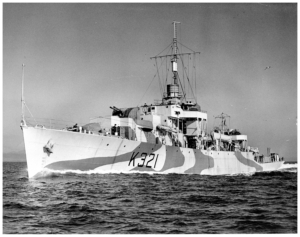
BRIEF HISTORY OF HMCS NEW WATERFORD
Constructed on Canada’s west coast, HMC Frigate NEW WATERFORD bore a name from the east coast. She was built by Yarrows, Ltd, at Esquimalt, B.C., and she was named after the coal-mining town of New Waterford in Cape Breton, Nova Scotia.
Launched on 3 July 1943, she was commissioned at 1330, 21 January 1944. Her first commanding officer was Acting Lieutenant-Commander E. R. Shaw, RCNR.
Trials had preceded her commissioning date and more followed it. It was for the purpose of undertaking these additional ones that she left Esquimalt on 29 January for Nanoose Bay and Vancouver.
A frigate of the River Class, NEW WATERFORD had the following specifications:
One of the early settlers of the town of New Waterford had his beginnings in the town of Waterford in Munster, Ireland, and this fact accounts for the derivation of the name of the former. One of the figures in the arms of Waterford is a dolphin. This animal is also featured in the ship’s badge, being given here a golden colour and placed on a background of wavy bars of blue and silver representing the sea.
The colours of the ship are blue and gold.
Since HMCS NEW WATERFORD was required for the anti-submarine war in the Atlantic, she left Esquimalt on 17 February with Halifax as her destination. Proceeding at thirteen knots and carrying out a continuous zigzag she entered the Straits of Juan de Fuca where she encountered a moderately heavy westerly swell which caused forty percent of the ship’s company, mainly inexperienced men or sailors who had been on the beach too long, to become sea-sick.
On 18 February identities were exchanged with US Aircraft Carrier Long Island.
During her career NEW WATERFORD was to make many attacks against suspected submarines but, interestingly enough, the first she ever made was delivered not in the Atlantic but in the Pacific. It was between 0300 and 0410Z on 20 February, some 140 miles west-north-west of San Francisco, that she obtained her first asdic contact. It was a very good one and she attacked it four times. No debris appeared on the surface but, after the last attack, an extensive underwater disturbance was observed. Contact was then lost and an attempt to regain it was not successful.
During these attacks some trouble was experienced when one of the port throwers fired a charge which struck the top of its loading rail, bending it and damaging the carrier. Repairs were carried out and drill in the ship corrected in order that the accident should not recur.
On 24 February, NEW WATERFORD met the RCN-manned escort aircraft carrier HMS Nabob, recently commissioned in Vancouver, and the two ships continued their voyage in company. The frigate proved to be of great assistance to her companion for she not only provided an anti-submarine screen but she was able as well to help in the carrying out of exercises sorely needed by the newly-commissioned carrier. This was particularly so for those intended for the Officers of the Watch and communications personnel.
On 1 March the two ships arrived in Balboa in the Canal Zone. Here, NEW WATERFORD required twenty-four hours to have repairs made to her starboard engine which had developed a heavy knock. At the same time authority was sought to permit the two ships to remain in company in the Atlantic as they had in the Pacific, as far as Norfolk, Virginia.
On 2 March the ships passed through the Panama Canal. Anchoring in Cristobal Bay on the Atlantic side, NEW WATERFORD waited for approval on the request. When this was received, she at 2310Z slipped and left Christobal with Nabob. The two ships set their courses as laid down for them by the routeing officer in Christobal, via the Windward and Mayaguana Passages.
Heavy weather met outside Colon obliged the ships to reduce speed temporarily to avoid damage. NEW WATERFORD’s long, low quarter-deck was found to be hazardous for personnel in bad weather when it was often swept by heavy waves. At times the oilers were prevented from getting to the tiller flat to attend to the telemotor steering gear.
On 4 March reports were received that U-boats were operating to the south-west of the Windward Passage. An anti-submarine search was instituted by four aircraft which were flown off Nabob’s deck at 1630Q. One of these aircraft failed to return to the carrier but was later reported as having landed safely at the Naval Air Station at Guantanamo Bay, Cuba. Following this, a continuous anti-submarine patrol was maintained by a single aircraft from dawn until dusk.
At 2107 on 7 March, the ships parted company, Nabob altering course to Norfolk at seventeen knots while NEW WATERFORD continued on to Halifax. Course was altered ten degrees off mean line of advance during five hours of bad weather to avoid racing of the propellers caused by heavy rolling.
When the frigate moved up to her jetty in Halifax on 9 March 1944, seven men and one woman stood there among others awaiting her arrival. They were citizens from the town of New Waterford which had already donated many gifts and comforts to the ship. These representatives of the town were welcomed aboard and shown about. After the tour, the visitors were entertained by the officers at dinner in the wardroom.
While in Halifax, NEW WATERFORD was subjected to more trials and she was also taken in hand for fitting out as a Senior Officer’s ship. On 27 March Lieutenant-Commander W. E. S. Briggs, was appointed to the command of the ship, replacing Acting Lieutenant-Commander Shaw.
At 2000 on 19 April 1944, NEW WATERFORD in company with HMC Corvette WETASKIWIN sailed for Bermuda, arriving the 22nd. She remained nearly a month, completing in the waters off the islands an intensive working-up programme. With HMC Corvette NORSYD she departed from Bermuda on 13 May.
On 19 May, Lieutenant-Commander Briggs, three officers and eleven ratings left Halifax to visit the town of New Waterford, thereby returning the call the eight citizens had made to the ship in March. On arrival the following day, the party was met by the Mayor, the Town Clerk and representatives of different organizations in the town. Dinner was served in various private homes. Then followed a visit to No. 12 Colliery, one of the largest coal producing mines in Canada. In the evening a dance was held.
After church and luncheon on Sunday, official welcomes were extended to the party by the Mayor and the representatives of the organizations. On Monday several citizens accompanied the party to Sydney to bid them farewell on their return journey to Halifax.
For the ship, more exercises followed, some of them in St. Margaret’s Bay near Halifax. Then on 19 June 1944, NEW WATERFORD left Halifax for Londonderry in Northern Ireland, arriving there on 26th. The frigate, of course, had missed the first stages of the Invasion of Normandy; nevertheless, the clouds of war were still rising up all along the French coast and enemy craft were waging a last desperate struggle in the Channel and all around the shores of Britain. In order that she might play her part in repelling this final dangerous thrust, NEW WATERFORD was allocated to the support group, EG-6. After remaining in Londonderry for three days, she departed on the 29th and joined the group the next day.
After meeting her new companions at 0700, she proceeded at 0730 to patrol off Eddystone Light near Plymouth, in company with HMC Frigates WASKESIU (Senior Officer) and OUTREMONT. At 1330, in response to a signal received from an aircraft reporting a submarine, the frigates increased speed to seventeen knots to close the position where it had been detected.
As they proceeded, the weather began to deteriorate. The wind rose accompanied by mist and rain. The aircraft had dropped flares marking the datum or point of contact and, when these were sighted, speed was decreased to seven knots, although this was later increased to thirteen as it was felt that the lower speed in such weather would make chances of catching the quarry small. Cat gear was also streamed. The other members of EG-6 – HMC Frigates CAPE BRETON and GROU and HM Frigate Cam who had been patrolling in another area, were ordered to the hunt. EG-2, an RN group, also joined. All these ships swept through the sighting position and then carried out a square search.
At 0800 the following day EG-2 left the area and was replaced at 1530 by EG-15, HM Frigates Louis, Inglis, and Mounsey.
On 2 July contacts were gained but, after attacks, were classified as wrecks. At 0917, NEW WATERFORD, OUTREMONT and CAPE BRETON were detached to screen HM Destroyers Eskimo and Javelin who had been in collision while returning from an offensive sweep in the approaches to Brest. EG-15 also departed, while WASKESIU, Cam and GROU continued to search between Lizard Head and Eddystone.
At 1440, with NEW WATERFORD and her companions back, the group left the Lizard area to sweep southwards to approximately sixteen miles north of Ushant, cruising north and south in the area at a moderate speed. A signal from Admiralty reported a radio bearing within twenty-five miles of the group and the sweep was altered to pass through the position, but no contact was obtained.
During the night of 3 July, a sweep was carried out in a north-south direction, keeping ten miles from Ushant. This patrol was altered the next day to one in an east-west direction as it was believed that the U-boats were stealing into the area by hugging the coast close inshore.
On the 6th more sightings by aircraft were investigated and a floating mine was sighted and sunk by Cam. The group proceeded to Plymouth on the 7th, arriving off Eddystone at 1200.
On 8 July 1944, at Plymouth, the now Acting Commander Briggs in NEW WATERFORD assumed his duties as Senior Officer of the group, taking over from the Commanding Officer of WASKESIU and, on the 11th, he led his ships out to a patrol south-east of the Isle of Wight. On the 12th there were two searches for reported submarines and another on the following day. Also on the 13th, OUTREMONT attacked what appeared to be, judging from the appearance on the surface of a large baulk of timber covered with barnacles, an old and well-embedded wreck. CAPE BRETON attacked another on the 14th. On the same day CAPE BRETON and WASKESIU each sighted the body of a German airman. These corpses were recovered and later recommitted to the deep.
NEW WATERFORD and CAPE BRETON proceeded into Portsmouth on the 15th, while the remainder of the group continued on patrol twenty-five miles north of Cherbourg, protecting the cross-Channel routes. On the 18th, NEW WATERFORD and CAPE BRETON relieved these ships.
Through August, EG-6 kept up its patrols in the waters around the cross-Channel convoy route, from the Isle of Wight to Cherbourg. Hunting went on ceaselessly, day after day, night after night. Although they were operating in areas where there were known to be U-boats, they did not come into contact with them, except possibly on the 19th, when ANNAN and CAPE BRETON attacked promising contacts; but the experience was one shared by anti-submarine forces in this last phase of NEPTUNE when the U-boat was beginning to develop its bottoming tactics.
Since each ship in turn passed a day or two weekly in harbour in Portsmouth, the group was never complete on these patrols. Such gaps in the ranks, however, were made up for by other ships who joined for short periods as, for example, HMC Corvette DRUMHELLER, HM Corvette Pennywort and HM Frigate Rowley.
In September the group, after a lay-over in habour, began a patrol of the area between Pendeen and Trevose, both on the West Cornish coast. Besides patrolling, the ships supported several convoys through the area. These were taken from or handed over at their borders to EG-9, HMC Frigate SWANSEA (Senior Officer).
On 10 September 1944, the group sailed to Londonderry where they still were, cleaning their boilers, when ten days later OPERATION NEPTUNE came officially to an end.
The group left Londonderry on 24 September. On the 25th, a depth-charge attack pressed by NEW WATERFORD brought to the surface oil, timber and various other objects. This was never proven to be a submarine.
Members of the group at this time were NEW WATERFORD, GROU, CAPE BRETON, Loch Morlich, Loch Achanalt, OUTREMONT, and ANNAN. Four of these ships were detailed by the Senior Officer, NEW WATERFORD, to patrol the convoy route from Lundy Island (off the Bristol Channel) to Trevose Head and the remainder to support convoys between Longships (off Land’s End) and Trevose Head.
At 1736 the 25th, the group left patrol to proceed to Scapa Flow for fuel and orders. They arrived there the 28th and sailed the following day to patrol off the Faeroes. GROU who had been delayed by defects rejoined the group at 1600, 1 October 1944.
At 0830 on 2 October, the escort aircraft carriers HM Ships Trumpeter and Fencer were met. The carriers were being escorted by HM Destroyers Cassandra, Caprice, Cambrian, Myngs and Savage and the Norwegian Destroyer Stord. When they joined this force, the 6th Escort Group came under the orders of Trumpeter. NEW WATERFORD passed the orders she had received in Scapa which related to two anti-submarine searches known as OPERATIONS “SJ” and “SK”. These were passed by coston line. On receipt of these orders, Trumpeter instructed the group to split into three pairs and carry out an anti-submarine search. They were to keep five miles apart by day and carry out their sweep ten miles ahead of the carriers. In their movements they were to be guided by aircraft reports. At dawn four Avenger aircraft would sweep the area and, during daylight hours continuous patrols were to be maintained around the force. By night, pairs of ships were to be stationed at ten-mile radii from the carriers, one pair on each bow and one pair astern. The speed of advance was to be sixteen knots, and the ships should zigzag.
NEW WATERFORD passed the operation orders also to Cassandra, then rejoined the group. She split EG-6 into pairs as ordered. All then proceeded. Due to the speed of the advance and the sea then running, it was not possible for the group to zigzag for, in fact, it was all the frigates could do to keep station ten miles ahead.
This patrol continued until 4 October when the carriers with their destroyer screen left the area. EG-6 went on patrolling. On the 8th, ANNAN parted company to proceed to Scapa to collect mail and stores for the group. At 1000, 9 October, course was altered for Skaalefiord in the Faeroe Islands. When the group was abeam of Nolso Island on the 10th, ANNAN rejoined from Scapa. NEW WATERFORD anchored off Thorshaven to receive instructions from NOIC, Faeroes, following the others later to arrive at Skaalefiord at 1730.
The patrol had been uneventful. What few asdic contacts had been gained had been classified as either schools of fish or whales.
The group left Skaalefiord at 0807, 14 October. Asdic conditions were good on the 16th and, as a consequence, the distance between the ships was increased to 4000 yards. Ships were in line abreast. Speed was eleven knots. The night was clear and the sea smooth with a slight swell.
At 1752Z, while sixty miles east-south-east of Munken Rock Faeroe Islands, the asdic cabinet in ANNAN reported an asdic echo at a range of 1200 yards. Course was altered toward the point indicated, although the Commanding Officer and the action asdic team were inclined to classify the echo as “doubtful”. As the frigate moved in, the contact passed down the port side and was regained astern at a range of two hundred yards. Range was opened to fourteen hundred yards and the depth-charge pistols set at “D”, the depth of the target being estimated at 150 feet. A pattern of charges was fired at 1819. No encouraging results followed upon this attack and ANNAN decided that she had come upon a tight school of fish or a number of whales. She reported this conclusion to NEW WATERFORD. The truth of the matter is, however, her quarry was a U-boat. Its hydrophone and torpedo firing mechanism had been damaged in the attack and it had been forced to go deep in an attempt to escape. Hence, the contact was lost.
Having come to her conclusion, ANNAN at 1845 altered course to approximately 300 degrees to rejoin the group and increased speed to fourteen knots. The group in the meantime had turned 180 degrees that they might not draw too far ahead of the action. With ANNAN back to station they set a course of 313 degrees.
At 1906, Loch Achanalt reported a possible radar bearing at three and a half miles. She was ordered to investigate. Immediately afterward ANNAN picked up a small echo. She altered course in its direction and increased to full speed. Radar reported that the echo amplitude was increasing. This suggested that a submarine was surfacing in the vicinity. Accordingly, at 1912, rockets were fired and the illumination resulting revealed a submarine almost beam-on. ANNAN attacked at once, opening fire with her forward four-inch gun and Oerlikons at 2500 yards. The enemy was not slow to return the fire and his resistance was effective. At 1915 a shell burst in ANNAN’s radar hut, wounding the second operator and, at 1925, a shell through the port side of the instrument room, hit the motor alternator and put the asdic set out of operation. Previously the enemy was said to have fired a torpedo as well. Both the asdic cabinet and the quarter-deck had reported one running down the port side of the ship. The firing of such a weapon, however, was later denied by the U-boat captain.
ANNAN continued her fire. As soon as they could be brought to bear on the enemy, the after guns were used to reinforce the steady and blistering fire erupting from the forward guns. Course was then set to pass alongside the U-boat and, when in this position at 1930, starboard throwers were manned and the firing wedges drawn. The released charges were lobbed over the guardrail, hit the forecastle of the submarine, rolled off and exploded. The U-boat began to settle and the enemy moved hurriedly to abandon ship.
At 1932 the submarine sank. The engagement had cost ANNAN eight wounded, three seriously. Throughout the action, she had received good support in the form of illumination by star-shell from Loch Achanalt, OUTREMONT and NEW WATERFORD, the last at long range, while during the last few moments Loch Achanalt had cleared her guns on the then sinking U-boat, but the “kill” was largely ANNAN’s own.
While NEW WATERFORD screened the operation, forty-six survivors were picked up out of a reported complement of fifty-two. Among these was the Commanding Officer of the U-boat U-1006 it proved to be – who later stated that ANNAN had damaged him during her first attack at 1919 and thus obliged him to come up with the intention of trying to make a get-away on the surface.
At 2315, ANNAN detached for Scapa to land the three seriously wounded of her ship’s company.
Before this dramatic encounter had been brought to its conclusion, CAPE BRETON and GROU had been engaged with another contact which they had attacked vigorously. Contact had been lost after the attack and could not be regained although the other frigates, once U-1006 had been disposed of, had joined to help sweep over the area.
At 2140 German conversation and Morse wireless signalling were heard on the high frequency direction finder. About two hours before daylight it sounded very close. At 0715 origin was fixed at a position only six miles astern. Course was altered to investigate but no contact was obtained.
Large numbers of contacts were obtained on the 17th. Some were extremely clear and could not be classified as “non-sub” until one and, in some cases, two patterns were fired. Of these contacts which all had, CAPE BRETON’s seemed to be the most promising, judging from its perceptible movement. But no visible evidence could be gained after attack.
While they were setting their course for Londonderry the next day at 0800, the group was signalled by an aircraft that he was preparing to attack a positive submarine. Course was altered and speed increased to fifteen knots to close the position, the ships being disposed in line abreast 3000 yards apart. The aircraft was instructed to drop marine markers over the position. At 1035, the group arrived at the markers and NEW WATERFORD dropped a dan buoy to further mark the position. The sweep was continued past it for a distance of thirteen miles. EG-14 – HM Destroyer Duncan Senior Officer – which had been ordered to join the hunt, was sighted at 1200. EG-14, on coming up, took over control of the combined force. Under Duncan’s orders, EG-6 commenced an inner box search with four-mile sides around the dan buoy, while EG-14 formed an outer box search. The hunt went on until the next day when EG-6 resumed its interrupted course to Londonderry.
GROU acted as Senior Officer when, with OUTREMONT, ANNAN and Loch Morlich, she sailed from Moville 2 November. NEW WATERFORD had to return to Londonderry with a gyro defect, her Commanding Officer assuming temporary command of GROU. She did not rejoin the group until the 7th.
The group patrolled between Start Point in Devon and Portland Bill in Dorset. “Non-sub” contacts were numerous. Until 14 November there were eighteen in all.
The group left Plymouth on 16 November for still another patrol of this area. NEW WATERFORD, ANNAN and GROU made a seventeen-mile square search for a ship reported to have sent out distress signals but did not sight her. There were several attacks pressed on “non-sub” contacts during this patrol.
On 7 December 1944, the group sailed from Moville to proceed to Larne, near Belfast, for anti-submarine exercises. At 1622 of the 9th, the frigates sailed for Scapa. Patrolling was resumed on the 10th.
During the forenoon of 12 December, while in the vicinity of Cape Wrath on the north-western tip of Scotland, twelve mines, believed to be of the British type, were sunk by the group. EG-6 then moved on to Milford Haven in Wales which they left on the 13th to patrol in St. George’s Channel between Wales and Ireland.
On Christmas Day, while supporting Convoy UC-50A, the group received a report from a Sunderland aircraft which was a part of the escort, of a positive Schnorkel being sighted. Permission was received from US Destroyer Clark, Senior Officer of the escort, to detach NEW WATERFORD and GROU who proceeded at full speed to the position, which was twelve miles from the convoy. On arrival a five-mile square was traced at a speed of thirteen knots. This square swelled out to one with ten-miles sides when ANNAN and Loch Morlich were detached to aid in the search. Several contacts were attacked. At 1245 of the 26th, NEW WATERFORD sighted and sank a mine. ANNAN obtained a contact on the 28th which occupied the attention of the group for the next five hours. No less than thirteen attacks were carried out. NEW WATERFORD contributing four depth-charge and two hedgehog. After the first attacks a light oil came to the surface and toward the last, fairly large patches of rust appeared with the oil. This led to the belief that the object under attack was the wreck of a tanker.
The Senior Officer noted that it was doubly disappointing that this hunt should have proved a fruitless one, for not only did the group fail to obtain a “Christmas present of German origin”, but they also lost the opportunity of receiving a gift promised them by USS Clark of chocolates and American cigarettes for the entire ship’s company.
From a wreck contacted on 30 December, Loch Morlich brought up an American life jacket and a large quantity of oil. From another NEW WATERFORD brought up tins, apparently of fruit juice, and bits of cardboard.
On 3 January 1945, the Landing Ship Infantry, HMS Persimmon was met at Milford Haven and, after her escort HM Destroyer Melbreak detached, was accompanied to Ailsa Craig.
On 11 January 1945 the ships Roanoke and Normandy Coast were torpedoed off Holyhead. Both of these ships sank, leaving sixty-seven survivors to be picked up.
EG-6 from Londonderry, and the RN Escort Groups 3, 21 and 31 were ordered to the scene. Assembled together they were known as “Force 36”. On arrival they began a search of the area. Inshore as well as off shore searches were carried out, one such taking place close inshore in Cardigan Bay in North Wales, the ships engaged moving in line abreast, one mile apart. But although there were the usual wreck contacts, there was nothing to suggest a living foe and, in the end, the fact that a killer had once more got safely away, had to be accepted.
On another patrol on the 22nd wreckage from the torpedoed SS Galatea was picked up. HM Frigate Tyler who was then in company with EG-6 sighted some rafts with a single survivor aboard. The group detached at 1130 to give aid to the French Corvette Renoncule who had what she believed to be a submarine contact. It turned out to be “non-sub”.
When she left Milford Haven on the 27th, NEW WATERFORD assumed the duties of Senior Officer of “Force 38” which was composed of EG-6 and the RN Escort Groups 5 and 21. These duties were taken over by Senior Officer of EG-5 the next day.
When, on 3 February, US Destroyer Mayo reported an anti-submarine contact and a torpedo passing down her port side, she was supported until she signalled that she believed it was all a false alarm. Later, she obtained another contact which may have been made off her same “probable submarine” and, after carrying out an attack, turned it over to NEW WATERFORD and Loch Achanalt. Following a squid attack by Loch Achanalt, NEW WATERFORD succeeded in obtaining an echo sounder trace which revealed that the contact had been made off a sharp pinnacle of rock.
EG-6 sailed from Moville on 17 February 1945 for Loch Alsh. Exercises were held there and they were found particularly valuable, especially those carried out in company with HM Submarine Seraph. Patrolling began in the vicinity of Longships on the 21st. Off Portland Bill on the 24th, EG-6 was joined by EG-26, HMC Frigate BEACON HILL (Senior Officer). A search was made on the strength of a U-boat contact made by HMC Corvette CALGARY in Lyme Bay between Dorset and Devon.
On 1 March 1945, NEW WATERFORD and Loch Achanalt anchored in Cherbourg Harbour after escorting two ships there with HM Frigate Hotham.
On 8 March, the report of the torpedoing or mining of a merchant ship was investigated out from Portsmouth. An aircraft sighting of a Schnorkel also came in for the group’s attention.
On 27 March, NEW WATERFORD, Loch Morlich, TEME and ANNAN sailed from Moville for the Plymouth command, via the Irish Sea. On the following day, at 2355, NEW WATERFORD and TEME proceeded to patrol Pendeen to Lizard Head. At 0630, the 29th, the two frigates met Convoy BTC-111 and trailed it four miles astern, remaining approximately two miles apart from one another, zigzagging independently. The sky was partly cloudy, the visibility five miles while the sea and swell were moderate with a seven to ten-mile breeze. Asdic conditions were good.
At 0706, TEME obtained an asdic contact. She was unable to hold it, losing it at 0710. As she did not signal for assistance, NEW WATERFORD did not join her. TEME attempted to regain the contact, hunting until 0724.
At this time, smoke was observed enveloping the after end of TEME. NEW WATERFORD signalled her, asking her what had happened, and she replied, “we have been torpedoed”. Action stations were immediately rung in NEW WATERFORD and course was altered to bring her up to her stricken companion. Seeing that the other was in no immediate danger of sinking, NEW WATERFORD began an intensive search around her.
Fifty to sixty feet of the after part of TEME was tangled rubble. At 1620, in fact, this section broke off clear. But the watertight after bulkhead of the stores flat held. When torpedoed, she had been inshore of NEW WATERFORD and now, with the wind setting her in an easterly direction and the tide in a southerly direction, she was drifting quietly into Whitesand Bay near Plymouth Sound. When the water became too shallow to drift further, she dropped anchor to await a tow.
In TEME one man was dead and three men were unaccounted for. It was believed that the latter had been thrown into the water by the explosion. The frigate lowered one of her boats to search for them but they were never found.
NEW WATERFORD went on searching for the prowler who had crippled her companion. In her search she chose an area which accorded with her belief that the torpedo had been fired from a position between the two frigates or from the inshore side of TEME.
The frigate soon had reinforcements to aid her in her hunt. ANNAN and Loch Morlich who were on patrol from Lizard Head to Start Point and the fleet minesweepers HMS Dornoch and Ilfracombe who were in the vicinity, were ordered to the area. A thorough search was made. Not content with covering the area of attack, NEW WATERFORD went into Whitesand Bay as far as she could, since it was thought the U-boat might have bottomed there. But the hunt was unsuccessful. Contacts were gained off wrecks and fish, but there was no sign of the undersea raider.
Meanwhile HMC Corvette MOOSEJAW detached from BTC-111 once the convoy was clear of the danger zone, and took TEME in tow. The frigate was eventually towed to Falmouth. Later, it was decided that in view of the extent of the damage to the ship and the pressure of work at the time in the dockyards, it would be inadvisable to take her in hand for repairs. Finally, on completion of reduction, she was handed back to the Royal Navy. She was paid off 4 May 1945.
While, in a dense fog on 12-13 April 1945, Convoy MKS-93 was being supported through the group’s patrolling area, another Convoy, ONA-296, was detected on a reciprocal course ahead. Because of the low visibility both convoys had to some extent lost formation and were straggling badly. On sighting one another, both made emergency alterations to starboard. Despite the alteration, however, the Commodore of one convoy collided with another merchant vessel. The commodore’s ship was damaged, the after-hold flooding.
NEW WATERFORD and ANNAN detached from their convoy to form a close screen on ONA-296, a west-bound convoy. Orders were then received from C.-in-C. Portsmouth to enter St. Helen’s anchorage, Isle of Wight, and disembark pilots. One minute later information followed from the same source stating that the eastern entrance of the port was closed by fog.
By 0630, with visibility nil and the convoy in such an unformed state, it was considered inadvisable to attempt to proceed westward or to close St. Helen’s. A number of the merchant ships managed to come to anchor in the vicinity of St. Helen’s, while others dropped their anchors and lay along an eight-mile circle with a centre four miles east by north of a buoy known as “EA5”. The frigates meanwhile tried to round up stragglers and guide them toward this latter area. NEW WATERFORD found one straggler who had given up trying to find the others and had chosen its own spot to anchor. This ship was allowed to remain in the position and NEW WATERFORD screened her. The other escorts formed a chain to the seaward of the vessels anchored in the circle described above.
At 2100, NEW WATERFORD and ANNAN received orders to detach and sweep to the westward.
At 1550 on 14 April 1945, NEW WATERFORD and ANNAN met Loch Morlich and Loch Achanalt and the four frigates proceeded to Londonderry.
With this entry into Londonderry, the Sixth Escort Group’s career as a “hunter-killer” force in the Channel was finished. The frigates had in fact been released by the Admiralty for operations in Canadian waters in view of increasing U-boat activity in the Western Atlantic toward the end of hostilities.
Consequently, at 1330, 18 April 1945, EG-6, NEW WATERFORD (Senior Officer), ANNAN, Loch Morlich and Loch Achanalt, sailed from Moville. A doubtful contact was attacked by Loch Achanalt at 1918 and at 0700 the following day the group met HMC Frigate SAINT JOHN who had sailed from Cardiff to join. Two hours later the newcomer attacked a doubtful contact.
At 1930, the group joined the convoy OS-123/KMS-97, HM Sloop Fowey Senior Officer of the close escort. The group took up positions in close screen on the convoy.
At 1940, NEW WATERFORD sighted what she took to be a U-boat trimmed down and closing the convoy to attack from the port quarter. One round was immediately fired from the twin four-inch gun. She was then called off by Fowey. The object was in fact a “battle practice target” in the tow of a target-towing vessel, Ocean Vigil, and had been previously identified by Fowey.
EG-6 detached from this convoy the next day. On the 21st a “suspicious wake” reported by Loch Morlich was investigated for two hours. This odd phenomenon may have been due to lighting effects caused by the prevailing cloud conditions.
The group arrived in Horta in the Azores on the 24th and departed the same day.
On the 27th, SAINT JOHN detached for Halifax and at 0200 the 28th, the remaining ships met Convoy HX-352 which was being escorted by the Local Northern Escort, EG W-3, HMCS PORTAGE (Senior Officer). EG-6 became an extended screen for this convoy of eighty ships, taking stations seven to eight miles ahead. At 1245, the mid-ocean escort, EG B-1, HM Frigate Chelmer (Senior Officer), took over duties as close escort from EG W-3. On the 29th, EG-6 detached to make a rendezvous with ONS-48 which she met next morning at 0420 under close escort of EG C-1, HMC Frigate HALLOWELL (Senior Officer). At first light the group moved from extended screen to positions in close screen. EG-6 detached from this convoy at 1630 on 2 May.
At 1730 on 3 May 1945, EG-6 arrived in Halifax.
On 14 May, NEW WATERFORD left Halifax to undergo a refit in Liverpool, N.S.
On 8 May peace had been signed with Germany. On 23 May EG-6 was formally dissolved. NEW WATERFORD’s erstwhile companions, ANNAN, Loch Morlich and Loch Achanalt, who had been loaned to the RCN by the RN, were ordered to return to the United Kingdom as soon as possible. They sailed on the 29th.
NEW WATERFORD’s refit at Liverpool was a long one. It was not completed until 26 November. In August it was decided that she would be tentatively selected for retention in the post war Royal Canadian Navy and would ultimately be used for training or be placed in reserve. She had a slight mishap in Liverpool. While at wharf there she suffered damage when OUTREMONT, on trying to come alongside, collided with her. The cost of necessary repairs resulting from this accident was estimated at $2,000.00.
On 29 November 1945 she left Liverpool with BEACON HILL and arrived in Halifax on the evening of the same day.
While in Halifax she carried out trials and visited a few neighbouring ports. On 2 January 1946, she went to Shelburne, N.S., for ammunitioning. On the 3rd, she left this town for Colon in the Canal Zone. Her destination being Canada’s west coast. It had been anticipated before this that five frigates would be sailed for duty in the Pacific, namely, NEW WATERFORD, ANTIGONISH, CHARLOTTETOWN, BEACON HILL and LEVIS.
NEW WATERFORD arrived in Colon on the 11th. She passed through the Canal and sailed from Balboa on the 13th. She passed three days at San Pedro, California, and arrived in Esquimalt on the 31st. Before she was paid off into the Reserve Fleet on 7 March she was despatched to Cox Island where, according to a report, there were distressed mariners in need of help. These turned out to be trappers who were in no need of assistance.
On 26 August 1946 she was taken in hand for a refit. In March 1948, she was docked and again in April 1949, January 1951 and April 1951. On 10 October 1951, she was transferred from the Reserve Fleet to the administration of Combrax (Commodore RCN Barracks), Esquimalt, under whose administration she was a tender for the use of the Mechanical Training Establishment. On 7 November 1952, as an interim solution to then prevailing congestion in HMCS NADEN, it was recommended that she act as well as an accommodation ship to relieve the strained facilities in barracks. Accordingly, on 9 January 1953, she underwent her second commissioning at 1700Z as a tender to HMCS NADEN. The personnel required for administration of the ship were kept to a minimum and were provided out of NADEN. Her Commanding Officer was Lieutenant J. C. Payne, RCN. In this role she was considered an integral part of NADEN, becoming in fact a floating barrack block. Since, during this period she would be keeping up steam, service in her would count toward promotional sea-time for the engineering mechanics.
On 28 August 1953, NEW WATERFORD was paid off a second time. Plans were now laid down to have her converted into the modern Prestonian Class frigate and, with this in mind, she was secured at Yarrows, Ltd, in Victoria, on 1 November 1954.
On 13 January 1955, while under care of the ship repairers, she suffered some damage when a wind of hurricane force with a maximum velocity of seventy-nine miles an hour, parted her forward mooring lines and carried the bow against a creosoted pile dolphin and the starboard quarter against a suction dredge. Damage, which was confined to the shell plating, was approximately $2,000.00. The piling or dolphin was damaged to the extent that total replacement was necessary.
NEW WATERFORD’s third commissioning date has been set for 31 January 1958.
The following battle honour has been awarded to the ship:
“Atlantic 1944.”
LIST OF COMMANDING OFFICERS HMCS NEW WATERFORD



 CFB Esquimalt Naval and Military Museum
 CFB Esquimalt Naval and Military Museum
 CFB Esquimalt Naval and Military Museum
 CFB Esquimalt Naval and Military Museum
 CFB Esquimalt Naval and Military Museum
 CFB Esquimalt Naval and Military Museum
 CFB Esquimalt Naval and Military Museum
 CFB Esquimalt Naval and Military Museum
 CFB Esquimalt Naval and Military Museum
 CFB Esquimalt Naval and Military Museum
 CFB Esquimalt Naval and Military Museum
 CFB Esquimalt Naval and Military Museum
 CFB Esquimalt Naval and Military Museum
 CFB Esquimalt Naval and Military Museum
 CFB Esquimalt Naval and Military Museum
 CFB Esquimalt Naval and Military Museum
 CFB Esquimalt Naval and Military Museum
 CFB Esquimalt Naval and Military Museum
 CFB Esquimalt Naval and Military Museum
 CFB Esquimalt Naval and Military Museum
 CFB Esquimalt Naval and Military Museum
 CFB Esquimalt Naval and Military Museum
 CFB Esquimalt Naval and Military Museum
 CFB Esquimalt Naval and Military Museum
 CFB Esquimalt Naval and Military Museum
 CFB Esquimalt Naval and Military Museum
 CFB Esquimalt Naval and Military Museum
 CFB Esquimalt Naval and Military Museum
 CFB Esquimalt Naval and Military Museum
 CFB Esquimalt Naval and Military Museum
 CFB Esquimalt Naval and Military Museum
 CFB Esquimalt Naval and Military Museum
 CFB Esquimalt Naval and Military Museum