Official History of
Caution: This article contains dated, biased and/or racist language.
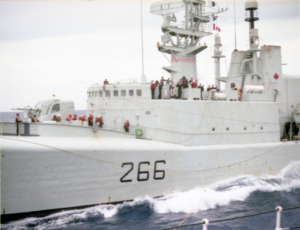
In warfare as in everyday life, the useful plodding ways are more frequently travelled than the more heroic or spectacular. Often their routes follow the margins of heroic events, even if they do not cross them. Such were the ways of HMCS NIPIGON, the subject of this narrative. A steam Bangor minesweeper, she was laid down in the yards of the Dufferin Shipbuilding Co. Ltd, in Toronto, on 4 July 1940, and launched on 30 September. Here, too, she was commissioned on 11 August 1941, with Lieutenant-Commander A. T. Morrell, RCNR, as her first Commanding Officer.
The ship’s name was derived from Nipigon Bay which is situated on the north shore of Lake Superior, at the mouth of the Nipigon River which flows into Lake Superior from Lake Nipigon. The name is variously interpreted as meaning “deep clear water” and “lake so long that you cannot see the end of it”. G. H. Armstrong states: “The word is a corruption of the Indian name, ANNIMIGON, meaning ‘lake that you cannot see the end of’, according to PICTURESQUE CANADA, edited by G. M. Grant. Mr R. Bell of the Geological Commission of Canada states Nepigon (sic) is Algonquin Indian meaning ‘a deep lake of clear water’. Other authorities derive the name from Aweenipigo, Indian for ‘the water which stretches far’”.
The newly-commissioned Bangor slipped at Toronto on 15 August, 1941, and proceeded to Montreal, visiting Kingston and Cornwall en route. With her arrival in Montreal, she entered dry dock for six days during which time the main injection was altered and the hull painted with anti-fouling. She was found to be greatly in need of supplies and equipment which had not been provided in Toronto. These had to be placed aboard. Held up in this manner she did not arrive in Halifax until 5 September, 1941.
In the east coast port NIPIGON began with minesweeping duties for which, indeed, she had been built. She underwent a successful trial on the 22nd and assumed regular ‘sweeping duties’ on the 25th. However, her possibilities as a convoy escort were of more importance at a period when so many merchant ships were falling prey to enemy submarines and, in October 1941, she was despatched to Sydney, N.S., to join the Sydney Local Escort Force. The Bangors could double as escorts and, indeed, in time came to be considered as such rather than as minesweepers, but their endurance was limited to less than 3000 miles at economical speed and this confined them pretty well to escorting convoys in coastal areas. The fact, however, did not limit their usefulness, because enemy submarines were already appearing in coastal waters and did not hesitate to attack there, particularly the unescorted ship.
NIPIGON’s first task with the Force was the escorting of four tugs. One of these returned to Sydney because of defects while a second detached some hours later to proceed to Halifax. The other two, Barwick and James E. Hughes, the Bangor conducted up toward Belle Isle. The weather, bad from the start on 9 October, worsened so that, on the 11th, in a persistently heavy sea and almost zero visibility, the ships were obliged to heave to north of Belle Isle at 2000. The visibility improving toward 2300, they set course for Forteau Bay, Labrador, to take shelter there. In these same waters no longer ago than 26 September, three ships of the transatlantic convoy, SC-46 – the steamships Culebra, Empire Kudu and South Wales – had stranded, the last two named being abandoned as total losses. Happily, NIPIGON’s small fleet was more fortunate. When it arrived the following morning, the tugs proceeded inside and anchored, while their escort maintained a patrol outside. Instructions were then received by the Bangor to return to base and, once she had assured herself that her charges were safe, she steamed back to Sydney.
Beginning with the closing days of November 1941, NIPIGON helped escort several SC convoys to the point east of Newfoundland where they were met by the mid-ocean escorts. Accompanying her in these duties were three or four corvettes. On several occasions, as with the 33-ship convoy, SC-57, NIPIGON assumed the duties of Senior Officer.
In December these duties were complicated by the weather. Heavy fog and snow seemed to be the rule and there was consequently much straggling among both the merchant ships and escorts. The Commodore of SC-61, for instance, with whom NIPIGON again performed as Senior Officer, could sight only twelve merchant ships on the morning following sailing, while NIPIGON was the sole discernible escort. The Bangor steamed ten miles to north and south in an attempt to contact the remaining ships of the convoy as well as her companions in the Local Escort Force, but without success. On the 23rd, however, she met the corvette, HMCS MATAPEDIA, who lent her support.
In Sydney on 9 January 1942, while alongside in the Sydney Dockyard, NIPIGON was struck on the port side forward by the corvette HMCS LOUISBURG while the latter was slipping from her berth. Some small repairs had to be made and then the minesweeper slipped to attempt to overtake the convoy, SC-64. At daylight the following morning, she was in its vicinity but was unable to see it because of the heavy snow. Later in the morning, she was able to join, but visibility became poor again during the night and did not improve again the next day. In addition there was a high sea running and a west-south-west gale. Only one ship was in sight, the British ship Empire Lynx, and NIPIGON proceeded to screen her. When visibility permitted, she looked about for the rest, carrying on her search until sunset of the 12th. Other escorting ships were finally met and with Empire Lynx being screened by the corvettes HMCS MOOSE JAW and HEPATICA, NIPIGON left the area to return to Sydney.
This was the final SC convoy of the season from Sydney before the harbour freeze-up. Succeeding convoys similarly designated were sailed from Halifax and, as a result, warships in the Sydney Force were transferred to the Halifax and Newfoundland commands as the demands on the port decreased. On NIPIGON’s return to Halifax she received orders to join the Bangors, HMCS CHEDABUCTO and UNGAVA, in a search for a U-boat which had been sighted by an aircraft at a position approximately ten miles north-east of Sambro Light Vessel. Contacts were obtained and attacks carried out by NIPIGON and CHEDABUCTO, but without significant results.
NIPIGON was now allocated to the Halifax Local Defence Force, being included among the “Moored Minesweepers, Bangor class”. The ships of this group carried out sweeps covering all approaches to Halifax for a distance of 20 to 25 miles. Specific stretches of water called “swept channels” were swept prior to and on the day of convoy.
On 30 January 1942, NIPIGON joined the coastal escort for SC-67, HMC Destroyer HAMILTON Senior Officer. HAMILTON detaching on 2 February, NIPIGON assumed the duties of Senior Officer. Later in the day she detached the corvette HMCS DUNVEGAN to search for the group attached to the Newfoundland Escort Force whose task it was to accompany the convoy in its transatlantic passage. When this force, which was made up of corvettes led by HMCS SPIKENARD, was sighted, junction was made and responsibility for the ships turned over. This was to be a memorable convoy, the first whose escorts would enter the port of Londonderry, Northern Ireland, and thus inaugurate the famous “Newfie-Derry” run which would last to the end of the war. For SPIKENARD, however, it was to be the end rather than the beginning. Torpedoed on the night of 10 February 1942, she never saw the green banks of the River Foyle which were to become such familiar sights to many Canadian sailors.
On 20 February 1942, NIPIGON was taken in hand for lessening of top weight. This work was completed on 7 March. Thus lightened she sailed as one of the escorts accompanying Convoy SC-76. This was a very slow convoy with an average speed of 5.93 knots, reducing at times to 4 knots. For the Senior Officer, HM Destroyer Veteran, maintaining contact with the convoy at such speeds was extremely difficult, owing to her increased fuel consumption at very slow speeds.
On 20 March 1942, the first BX convoys sailed on the Boston to Halifax route. Destroyers no longer fit for mid-ocean escort and Bangors were used to escort both of these convoys and the XB convoys which used the reverse route. On 9 April NIPIGON sailed with XB-8 and returned from Boston with BX-9. While with the latter on the 21st, she dropped a depth-charge on a “doubtful” contact. The ship worked hard in the ensuing months of a year when convoys were sorely beset by the enemy.
On 23 August 1942, in a dense fog, the steamship Awatea in AT-20, a troop convoy, rammed US Destroyer Buck, whose stern was sheared off as a consequence. Buck was taken in tow by US Auxilliary Oiler Chemung who later, on the 27th, was herself to ram and sink US Destroyer Ingraham. NIPIGON lent support to the towing operation, along with US Destroyer Tillman and US Fleet Tug Cherokee.
On 9 September, NIPIGON proceeded to Lunenburg, N.S., for a refit. Later she sailed to Liverpool and from this port to Halifax on 23 October and to Pictou on the 25th. She was undocked in the last port on 3 November. On the 16th of this month she sailed to Sydney to resume escort duties.
On 16 December 1942, US Transport Siboney was damaged in a collision with the British Ship City of Kimberley in Convoy HX-219 for which NIPIGON was one of the Local Northern Escorts. Siboney was able to reach Halifax under her own steam. NIPIGON screened her en route.
The frequently dense fogs and storms of winter brought many problems during the early months of 1943, straggling, of course, not being the least.
In February 1943, NIPIGON was lent to the Newfoundland Defence Force and during the month paid a call to the French island of Saint Pierre.
In April it was decided to number groups of the Western Local Escort Force (later designated as Western Escort Force or W.E.F.) from W-1 to W-14. NIPIGON was allocated to W-1, HM Destroyer Buxton Senior Officer. The WEF was based on Halifax and employed between that port and St. John’s, Newfoundland, Saint John, N.B., Boston, New York, and occasionally Sydney. Both local coastal convoys and the larger transatlantic ones in their coastal phases, were escorted.
NIPIGON carried out a search for survivors, reported by aircraft, on 24 May. On word that they had been recovered by US Destroyer Turner, the Bangor returned to base. Another search for survivors was carried out when the schooner Margaret K. Smith sank from unknown causes, believed an explosion, on 17 August 1943. Wreckage from her was first sighted by RCAF aircraft. Some drums of oil were salvaged but no survivors were found although several ships searched the area.
HM Destroyer Richmond assumed Senior Officer duties for the group in September, 1943, Buxton being “considered to be unfit for further escort duties due to continuing and serious defects”. Both these destroyers belonged to the group of fifty which had been exchanged by the US Government for certain base sites in British possessions in the western hemisphere.
On 8 September, SS West Point and SS James Longstreet, both in Convoy BX-72, were in collision in the vicinity of Sambro Light Vessel outside Halifax harbour. West Point sustained extensive damage which necessitated discharging cargo and dry docking. James Longstreet suffered minor damage. NIPIGON screened West Point until relieved.
Another of NIPIGON’s convoys during September was ONS-18. A few days before the Bangor and her group effected rendezvous, it along with a faster convoy, ON-202, which had overtaken it, had been subjected to severe attacks, successful from the enemy standpoint owing to the use of the GNAT, a new acoustic torpedo. Seven merchantmen and four escort ships, including HMC Destroyer, ST. CROIX, had been torpedoed.
In October 1943, while escorting ON-204 to New York, NIPIGON developed defects and returned forthwith to Halifax for repairs. These were completed at the beginning of November.
Until 16 February 1944, when she sailed to Lunenburg, N.S., to begin a refit, NIPIGON was associated with the corvettes BARRIE and ARROWHEAD in the escorting of convoys between Boston and Halifax.
Following her refit in Lunenburg NIPIGON sailed on 4 April to Liverpool for further repairs. Back in Halifax on the 29th, she left this port on 12 May for Bermuda to carry out working-up exercises.
For the remainder of the year, the ship plied her busy and useful career as escort. In December she was present when, on the 24th of the month, the Bangor minesweeper, HMCS CLAYOQUOT, was sunk off Halifax with the loss of eight lives. At the time she was an escort for the 12-ship convoy, XB-139, HMCS TRANSCONA, Senior Officer. TRANSCONA, who was preparing to take up her station on the convoy, was a half-mile from CLAYOQUOT when the torpedo struck. Later both TRANSCONA and the corvette, HMCS FENNEL, reported mysterious explosions occurring in or about their CAT gear which were probably caused by GNATS or acoustic torpedoes. A search in which all available escorts took part, proved to be unsuccessful.
On 4 January 1945, Convoy SH-194 which was composed of three ships escorted by the Bangor minesweeper, HMCS KENTVILLE, was steaming staggered line abreast when, two of the ships, Nipiwan Park and Polarland, were successively torpedoed. The third ship was ordered by KENTVILLE to zigzag and proceed to Halifax at best speed. After she had carried out the usual preliminary search, KENTVILLE picked up five survivors from Polarland and twenty-five from Nipiwan Park. NIPIGON then came up and the two Bangors were joined by the trawler, HMS Manitoulin. A ten-mile search was begun to seaward of the torpedoings. No submarine was sighted, no torpedo tracks were seen, and no contact was gained by asdic.
The attack on the 20-ship convoy BX-141 on 14 January, 1945, was a daring one under the circumstances. NIPIGON was an escort along with the Bangor steam minesweeper, HMCS WESTMOUNT. Supporting were three frigates from Group EG-27: MEON, COATICOOK and ETTRICK. Visibility was about five miles, the sky overcast and the wind easterly. The ships had formed line ahead to pass through the swept channel to enter Halifax harbour when the third in line, a large tanker, British Freedom, was hit on the port side of the engine room. She began to settle and soon had to be abandoned. Meanwhile an American “Liberty” ship, SS Martin Van Buren, and a British tanker, M.V. Athel Viking, were torpedoed in the sterns. For a time both these ships remained afloat. The “Liberty” ship was taken in tow some hours later but broke adrift, drifted off to the shore in the vicinity of Ketch Harbour and became a total loss. At the same time the tugs had failed to find the tanker. She had sunk with her master and four members of her crew after determined efforts had been made to keep her afloat. Searching for the U-boat following the attack, ETTRICK and MEON carried out depth-charge attacks on contacts gained between the channel and the Blind Sisters rocks without visible results. During these attacks ETTRICK lurched as if she had run on a mud bank and it subsequently became evident that a propeller had been slightly damaged and a slight leak opened in her bottom. Meon reported detecting a torpedo near her.
Both NIPIGON and WESTMOUNT screened the surviving ships. Once the latter were safe, the Bangors were taken under orders by EG-27 and they joined in the intense hunt for the killer. The US Task Group 22.9 was also diverted to the area. A U-boat which had been suspected of being the attacker on this convoy, made a wireless transmission at a point far to eastward of the area at 0414/23, which fact prompted final action on abandoning the search.
NIPIGON continued with her duties until 9 March when she proceeded to Lunenburg for a refit. There was a further refit in Halifax from 19 June to 9 July, when the ship sailed to Digby, N.S., to carry out working-up exercises. She returned to Halifax on the 21st.
By this time the war in the Atlantic was over and the last convoy had long since reached its destination. The Bangors were now employed on short cruises and as emergency ships. They were formed into the First and Second Canadian Minesweeping Flotillas, NIPIGON joining the First. These ships carried out minesweeping manoeuvres and exercises.
On 7 August 1945, SS Argos Hill, en route from London to Philadelphia, took fire at a position south of Newfoundland, and had to be abandoned. Several ships sailed to her assistance, among these being NIPIGON and two fellow Bangors, HMCS SWIFT CURRENT and GRANDMERE. With the exception of one man who died in the fire, the crew were picked up by SS Noah Brown and Montclair Victory.
By September 1945, those of the Bangors who had gone overseas and performed such outstanding service during the Invasion of Normandy and later, were back. The Pacific War had ended on 14 August 1945. The RCN now had to face the problem of reducing its establishment to peace-time strength. A reduction in its budget in fact made imperative the paying off of most of its ships.
It was decided that the larger escort vessels such as frigates were of more value to the Navy than minesweepers, and consequently the latter bore the brunt of the reduction programme. Of the steam Bangors, only QUINTE was retained in service. The remainder – thirty-four of them – were turned over to the War Assets Corporation for disposal.
In accordance with the decision, NIPIGON in company with WESTMOUNT was sailed to Shelburne on 30 September to land ammunition. Both ships left this port on 1 October to proceed to Sydney for destoring. On the 10th, NIPIGON returned to Shelburne in company with sister steam Bangors, HMCS WESTMOUNT, PORT HOPE, and GANANOQUE. She was paid off in this port on 13 October, 1945.
The course taken by the “cold war” profoundly affected the futures of many of the paid-off ships. Because of it, it was decided ultimately to return to service, or at least to make available for service, some of those – frigates and Bangors – that had been disposed of in 1945 and 1946. Consequently, in the autumn of 1948, eighteen frigates and nineteen Bangors – the latter later reduced to eighteen with the scrapping of WASAGA – held by Marine Industries Ltd of Sorel, were “frozen” and later classified as a “strategic reserve” for the RCN. These ships, of which NIPIGON was one, remained at Sorel but were under the control and maintained at the expense of the Canadian Government. Not until 9 July 1951 were they formally repurchased.
Following their reacquisition the Bangors underwent a reconstruction and refit programme and were then placed in the Reserve Fleet at Sydney. Remaining in this port until the summer of 1957, NIPIGON and nine others were brought out to be reconditioned, refitted and re-equipped for transfer to Turkey under the programme of Mutual Aid to member nations of the North Atlantic Treaty Organization (NATO).
On 29 November 1957, Canada turned over to Turkey the first five of what were known as “Bangor” Class coastal escorts. NIPIGON was among these five. She was renamed Bafra.
At the ceremony for the transferring of the ships, held at the Point Edward Naval Base, Sydney, the Canadian Government was represented by Hon. George R. Pearkes, V. C., Minister of National Defence, and the Turkish Government by His Excellency Ahmet Cavat Ustun, Turkish Ambassador to Canada. Representing the RCN were the following: Vice-Admiral H. G. DeWolf, CBE, DSO, DSC, CD, RCN, Chief of the Naval Staff; Rear-Admiral H. N. Lay, OBE, CD, RCN, Vice-Chief of the Naval Staff; Rear-Admiral H. F. Pullen, OBE, CD, RCN, Flag Officer Atlantic Coast; and Rear-Admiral (E) W. W. Porteous, OBE, CD, RCN, Chief of Naval Technical Services.
By this transfer the first ship bearing the name of NIPIGON has left the Royal Canadian Navy, but the name, to which she gave distinction by faithful service in the North Atlantic, remains. It will be borne soon by a new “Mackenzie” Class destroyer escort who no doubt will add to it new honours and renown.
The following battle honour has been awarded to HMCS NIPIGON:
ATLANTIC 1941-45.
LIST OF COMMANDING OFFICERS
HMCS NIPIGON
11 August 1941 to Lieutenant-Commander A. T.
14 February 1942 Morrell, RCNR.
15 February 1942 to Acting Lieutenant-Commander
11 May 1942 C. A. King, DSC, RCNR.
12 May 1942 to Lieutenant J. Brock, RCNVR.
4 October 1942
5 October 1942 to Lieutenant W. J. Piercey, RCNR.
28 March 1944
29 March 1944 to Lieutenant W. Turner, RCNR.
11 April 1944
12 April 1944 to Lieutenant D. R. Baker, RCNVR.
4 February 1945
5 February 1945 to Lieutenant J. R. Brown, RCNVR.
13 October 1945
Naval Historical Section,
Naval Headquarters,
Ottawa, Ontario.
21 September, 1959.
Footnotes
- Particulars of HMCS NIPIGON are as follows:
Standard displacement:672 tons
Extreme length:180’
Extreme breadth: 28’ 6”
Draught: 8’ 4”
Armament: 1 – 4” gun
2 – 0.5 twin Colt machine-guns
2 Lewis guns
2 depth-charge chutes
2 depth-charge throwers.
2.ENCYCLOPEDIA CANADIANA, Ottawa, 1958.
3.THE ORIGIN AND MEANING OF PLACE NAMES IN CANADA, Toronto, MacMillan, 1930.
4. This did not prevent many of them from providing invaluable service as minesweepers during the Normandy Invasion.
5. SC convoys ran from Sydney or Halifax to the United Kingdom.
6. Westbound transatlantic convoy.
7. The torpedoed warships, besides ST. CROIX, were HM Frigates Lagan and Itchen and HM Corvette Polyanthus. Itchen picked up many survivors from ST. CROIX and one from Polyanthus. Three men were rescued when she sank: one from her own ship’s company, one from ST. CROIX and the lone survivor from Polyanthus.
8. CAT gear: noise-making device towed astern to divert acoustic torpedoes.
9. TG 22.9 was one of two US task groups – the other was 22.10 – each consisting of four destroyer escorts who, on 6 January 1945, were placed under the operational orders of the Commander-in-Chief Canadian North-west Atlantic, by the Commander-in-Chief of the US Atlantic Fleet. These groups carried out patrols and searches off Halifax as required.
10. Argos Hill was the former Canadian Constructor. Her superstructure was completely demolished in the fire. On the 13th, she was towed to Bay Bulls, Newfoundland, by HM Rescue Tug Tenacity. She was sold in 1946 to interests in Grand Cayman Island.