Official history of

Official history of
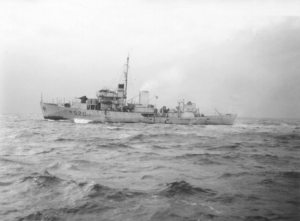
HMCS NORSYD was built at Quebec by the Morton Engineering and Dry Dock Co. Her keel was laid on 14 January 1943, she was launched 31 July and commissioned on 22 December of the same year. She was named for the town of North Sydney, Nova Scotia. The pennant number painted on her side was K-520.
She was a corvette of the Revised “Flower” Class with increased endurance. She displaced 970 tons and measured 208’ 4” in length, 33’ 1” in the beam with a draught of 16’ at full load. Her triple-expansion, four-cylinder engine developed 2,750 horse-power, propelling her at a top speed of 16 knots. Her armament comprised one 4-inch gun, one 2-pounder pom-pom, two singly mounted 20-mm. Oerlikon guns, two rails, two traps and four throwers for depth-charges, and a hedgehog – a multiple spigot-mortar throwing a ring of twenty-four anti-submarine bombs.
The St. Lawrence River freezes up from late December until April so, although she was not complete, NORSYD was commissioned on 22 December and after being delayed by the weather, sailed on 26 December from Quebec, threading her way through the floating ice. After a call at Halifax, she went to Saint John, New Brunswick, to complete her fitting out, remaining there until 16 March 1944. Halifax Dockyard then put the finishing touches to her equipment, and she sailed on 21 April for Bermuda where she spent three weeks on “working-up” exercises.
Arrived back in Halifax, NORSYD was assigned to the Western Local Escort Force, responsible for escorting convoys between New York and St. John’s, Newfoundland. She took up this duty when she sailed on 21 May 1944 and remained constantly engaged in it until the end of July when she called at North Sydney for a visit to her namesake town and to clean her boilers. On 6 August she returned to duty, but was soon assigned to the Gulf of St. Lawrence.
U-boats had entered the gulf and sunk ships there in 1942, but had not returned since. However, in September 1944 they came back and NORSYD sighted one on the surface on the night of 7th/8th. She engaged it with gun-fire, but without success.
In October she returned to the “Triangle Run” – Halifax, New York, St. John’s, but was transferred to the Mid-Ocean Escort Force on 21 November. Her new duties took her across the Atlantic six times with convoys, but the U-boats had suffered a severe defeat in 1943 and were no longer able to oppose effectively the passage of convoys. On 30 March 1945, she arrived in Saint John, New Brunswick, where she was to be refitted.
With the end of the war in Europe and the Atlantic, corvettes were no longer required, and she was paid off after jettisoning ammunition and landing stores. On 25 June 1945, she was laid up at Sorel, Quebec, and turned over to the War Assets Corporation for disposal. She was sold on 2 October to the United Ship Corporation of New York, for scrapping, but later appeared in the Israeli Navy renamed Haganah.



 CFB Esquimalt Naval and Military Museum
 CFB Esquimalt Naval and Military Museum
 CFB Esquimalt Naval and Military Museum
 CFB Esquimalt Naval and Military Museum
 CFB Esquimalt Naval and Military Museum
 CFB Esquimalt Naval and Military Museum
 CFB Esquimalt Naval and Military Museum
 CFB Esquimalt Naval and Military Museum
 CFB Esquimalt Naval and Military Museum
 CFB Esquimalt Naval and Military Museum
 CFB Esquimalt Naval and Military Museum
 CFB Esquimalt Naval and Military Museum
 CFB Esquimalt Naval and Military Museum
 CFB Esquimalt Naval and Military Museum
 CFB Esquimalt Naval and Military Museum
 CFB Esquimalt Naval and Military Museum
 CFB Esquimalt Naval and Military Museum
 CFB Esquimalt Naval and Military Museum
 CFB Esquimalt Naval and Military Museum
 CFB Esquimalt Naval and Military Museum
 CFB Esquimalt Naval and Military Museum
 CFB Esquimalt Naval and Military Museum
 CFB Esquimalt Naval and Military Museum
 CFB Esquimalt Naval and Military Museum
 CFB Esquimalt Naval and Military Museum
 CFB Esquimalt Naval and Military Museum
 CFB Esquimalt Naval and Military Museum
 CFB Esquimalt Naval and Military Museum
 CFB Esquimalt Naval and Military Museum
 CFB Esquimalt Naval and Military Museum
 CFB Esquimalt Naval and Military Museum
 CFB Esquimalt Naval and Military Museum
 CFB Esquimalt Naval and Military Museum